Online Certification Exams: The Complete Guide
An online certification exam is a remotely delivered test that determines whether a candidate earns a professional credential, a certification, license, or formal qualification, rather than a course grade or a hiring decision. That distinction matters more than it might seem: a certification exam's result carries legal and professional weight a classroom quiz never does, which changes what "secure enough" and "verified enough" actually mean.
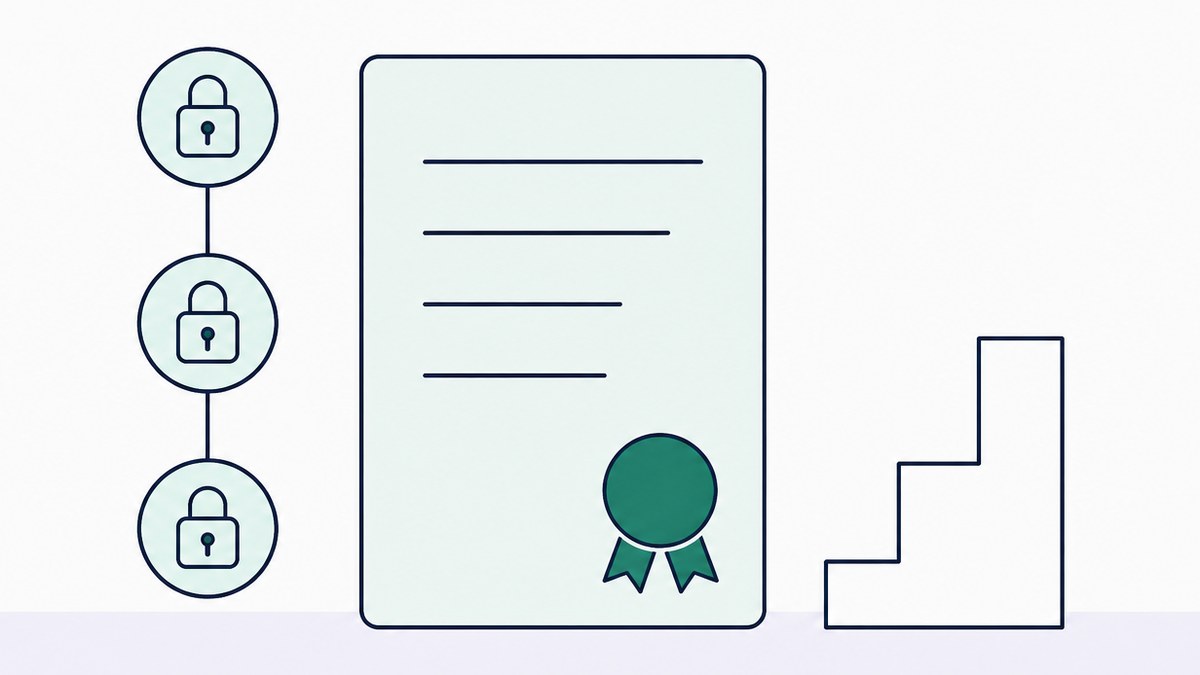
What is in this guide
This guide covers what's genuinely different about running a certification exam online, administering it, proctoring it appropriately for the stakes involved, and verifying candidates with the rigor a credential demands. If you're setting one up now, jump to How to Run an Online Certification Exam for the practical starting point.
How to Run an Online Certification Exam
Administering a certification exam online involves more moving parts than a typical course assessment, largely because the exam's output - a credential - needs to hold up to scrutiny long after the exam itself is over.
Getting the administrative process right before you even think about the exam-day technology is what separates a certification program that holds up to outside scrutiny from one that doesn't. For the full step-by-step breakdown, read How to Run an Online Certification Exam
- Define eligibility criteria clearly before candidates ever register - prerequisites, required documentation, and application review all need to happen before exam access is granted, not during
- Build the exam content to a defensible standard - questions should map to a documented set of competencies the credential is meant to certify, not an ad hoc question bank
- Plan for results issuance and record-keeping, not just scoring - a certification exam typically needs a retained, auditable record of who took it, when, and what score they achieved, since credentials get verified by employers or licensing boards long after the exam date
- Decide your retake and appeals policy in advance, since a failed certification attempt carries more weight for a candidate than a failed course quiz, and disputes are more likely to be pursued formally
How to Proctor Certification Exams Online
Proctoring a certification exam calls for a different calibration than proctoring a classroom quiz, largely because the cost of a false credential is much higher than the cost of an inflated grade.
This overview covers what's specific to certification stakes. For the underlying monitoring technology itself, how AI behavioral detection actually works, what it can and can't catch, that ground is covered in full in our proctoring cluster; see How Does AI Proctoring Detect Cheating? and Are Online Proctored Exams Secure? for the technical depth. For the certification-specific proctoring decisions covered here, read How to Proctor Certification Exams Online
- Match proctoring rigor to the credential's stakes - a professional license with real-world safety implications warrants tighter monitoring than a low-stakes internal certification
- Decide between live, AI-based, and hybrid proctoring based on candidate volume and how defensible a result needs to be if formally challenged
- Build identity verification into the proctoring flow itself, not as a separate step, since confirming who took the exam is as central to a certification's validity as monitoring what happened during it
- Document your proctoring methodology, since certification bodies are sometimes asked to explain how a result was secured, particularly if a credential is challenged or audited
How to Verify Candidates During Online Exams
Identity verification carries different weight in a certification context than almost anywhere else - a credential earned by the wrong person isn't just an academic integrity problem - it's a professional trust problem that follows the candidate into their career.
- Use multi-step verification rather than a single check - combining a login credential, a one-time code, and a photo match provides more assurance than any one method alone
- Verify identity at more than one point, not just at login, since a substitution attempt partway through a long exam is a real risk for high-value credentials
- Retain verification records alongside exam results, so identity confirmation is part of the auditable record a certification body may need to produce later
- Set verification rigor proportionate to what the credential unlocks - a certification that gates professional practice warrants stronger verification than an entry-level internal badge
Why Certification Exams Need a Higher Bar
Certification and licensing exams are generally held to a stricter standard of validity and security than typical classroom or hiring assessments, and it's worth understanding why rather than treating it as an arbitrary extra layer of caution.
This is the throughline connecting all three pieces above: administration, proctoring, and verification all exist in service of a credential that needs to hold up under scrutiny well beyond exam day itself.
- A credential is a public claim - when someone lists a certification, employers, clients, or regulators are relying on that claim being true, which is a very different downstream use than a grade that mostly matters to the student themselves
- Accreditation and standards bodies often set explicit expectations for exam validity, security, and candidate verification that certifying organizations are expected to meet and, in some fields, formally demonstrate
- The legal exposure is real - a certification obtained fraudulently, or a credentialing process that can't defend its own integrity, creates liability for the certifying body, not just a fairness problem for other candidates
- Trust compounds across the whole credential, not just individual results - if one exam administration is shown to be insecure, it can call the value of every credential the program has issued into question
What TunnelQuiz Can and Can't Do for Certification Exams
Being direct about this upfront saves everyone time: TunnelQuiz is built for browser-based, multiple-choice and written-answer proctored exams - it's a strong fit for certification exams that assess knowledge and applied reasoning through that format.
If your certification exam is knowledge-based and fits the MCQ/written-answer format, this is a genuine fit. If it requires hands-on skill verification, that's worth knowing before building your process around any software-only platform, TunnelQuiz included.
- Good fit - knowledge-based certifications, professional concept exams, compliance and regulatory certifications, and any credential where the underlying competency can be validly assessed through structured questions
- Not a fit on its own - certifications requiring live practical or hands-on skill demonstration (a clinical procedure, a trade skill, an in-person physical assessment), which need a different delivery method entirely, sometimes in-person or hybrid by regulatory requirement
- Where TunnelQuiz specifically helps - identity checks through an email one-time code and, from the Essential plan, a check-in photo and webcam snapshots, shuffled questions and random question pools for exam integrity, tests you can duplicate for each new administration, instant auto-grading, and retained results reports for record-keeping, shareable as view-only links from the Essential plan
Questions, answered
An online certification exam is a remotely delivered test that determines whether a candidate earns a professional credential, license, or formal qualification, rather than a course grade or hiring outcome. It typically involves eligibility verification, identity confirmation, and a retained, auditable record of the result.
Generally, yes, when administered with appropriate identity verification, security measures, and documentation, though specific legal validity depends on the certifying body, the profession, and any applicable regulatory requirements. Some licensing exams have specific regulatory requirements around delivery format that should be confirmed with the relevant accrediting or licensing authority.
A certification exam determines eligibility for a professional credential that others will rely on, which generally requires a higher standard of validity, security, and candidate verification than a typical classroom or internal training assessment. The stakes and downstream trust placed in the result are what drive this higher bar, not the exam format itself.
No, certifications requiring hands-on or practical skill demonstration, such as certain clinical or trade certifications, generally can't be fully validated through a remote, software-only format and may require in-person or hybrid delivery. Knowledge-based certifications are much better suited to a fully online format.
Multi-step verification, combining a unique login credential, a one-time code, and a photo match, provides stronger assurance than any single method alone, and verification at more than one point during the exam adds protection against mid-exam substitution. The right level of rigor should scale with what the credential actually enables professionally.
Yes, generally, certifying organizations typically need a retained, auditable record of who took an exam, when, their result, and how identity was verified, since credentials are often checked or challenged well after the exam date. This record-keeping is a core part of what makes a certification defensible if it's ever formally questioned.
Proctoring rigor should scale with the credential's stakes - a professional license with real-world implications warrants tighter monitoring than a lower-stakes internal certification. Documenting the proctoring methodology used also matters, since certifying bodies are sometimes asked to explain how a result was secured.
If your certification program fits a knowledge-based, MCQ, or written-answer format, TunnelQuiz handles identity checks, exam security through shuffled questions and random question pools, and retained results reporting directly in the browser, built for exactly this layer of the certification process, without requiring you to stitch together several separate tools.
- Free plan, 50 credits a month
- No install, runs in the browser
- Screen capture on every plan
- MCQs scored the moment they submit