How to verify candidates during online exams
A credential earned by the wrong person is not an academic integrity problem, it is a professional trust problem. Multi-step verification, and when to repeat it.
In short
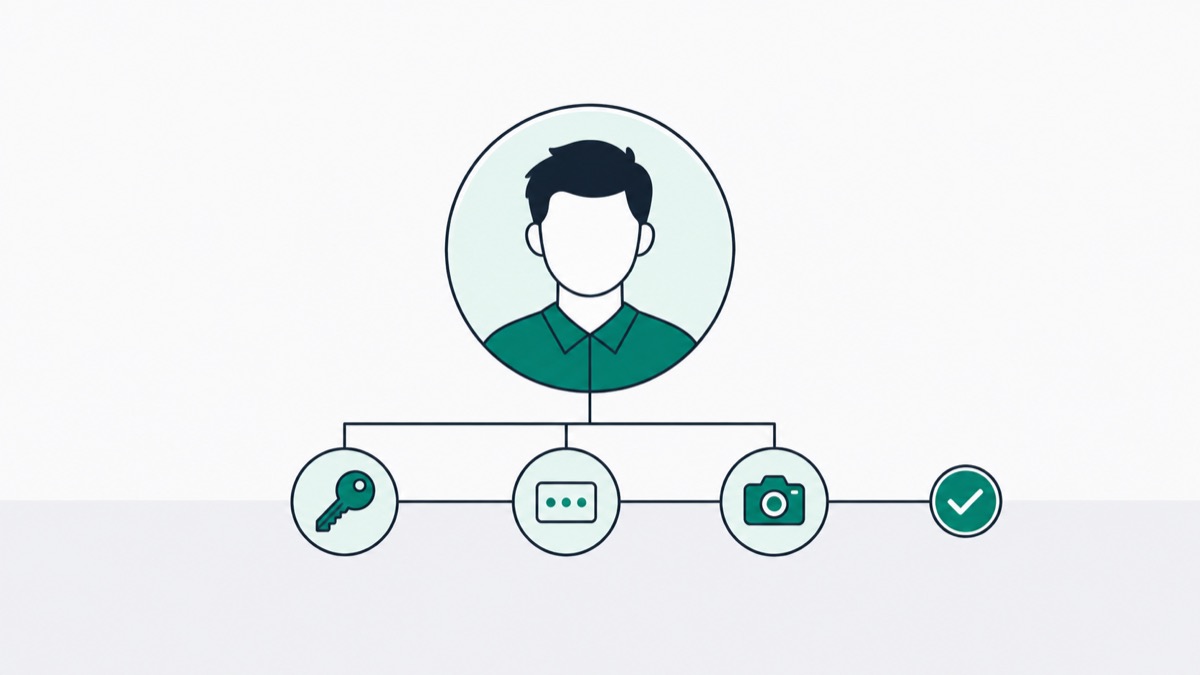
Verify at more than one point, not just at login: mid-exam substitution is a real risk on a long, high-value exam.
Verifying candidates during an online exam means confirming, at the start and ideally throughout the session, that the person taking the exam is actually the registered candidate, not someone testing on their behalf. For a certification exam specifically, this isn't a nice-to-have; a credential earned by the wrong person isn't just a fairness problem - it's a false professional claim that follows that person into their career.
This guide covers the verification methods available, how to layer them, and how to calibrate rigor to what a specific credential is worth. For the broader certification exam process, see our complete guide to online certification exams.
Why a Single Check Isn't Enough
A common mistake is treating identity verification as one step completed at login and never revisited. Traditional password-and-login authentication alone is increasingly considered insufficient on its own, since credentials can be shared, guessed, or compromised, and a login check says nothing about who's actually sitting at the keyboard once the exam starts.
- A login check confirms access, not identity - someone with the right credentials isn't necessarily the registered candidate
- A single verification at the start doesn't protect against mid-exam substitution, where a different person takes over partway through a long exam
- Relying on one method creates a single point of failure - if that method is spoofed or bypassed, nothing else catches the impersonation
This is why verification is increasingly treated as a layered process combining multiple methods, not a single gate at the door.
The Core Verification Methods
Certification programs typically draw from a combination of these methods, each addressing a different part of the verification problem.
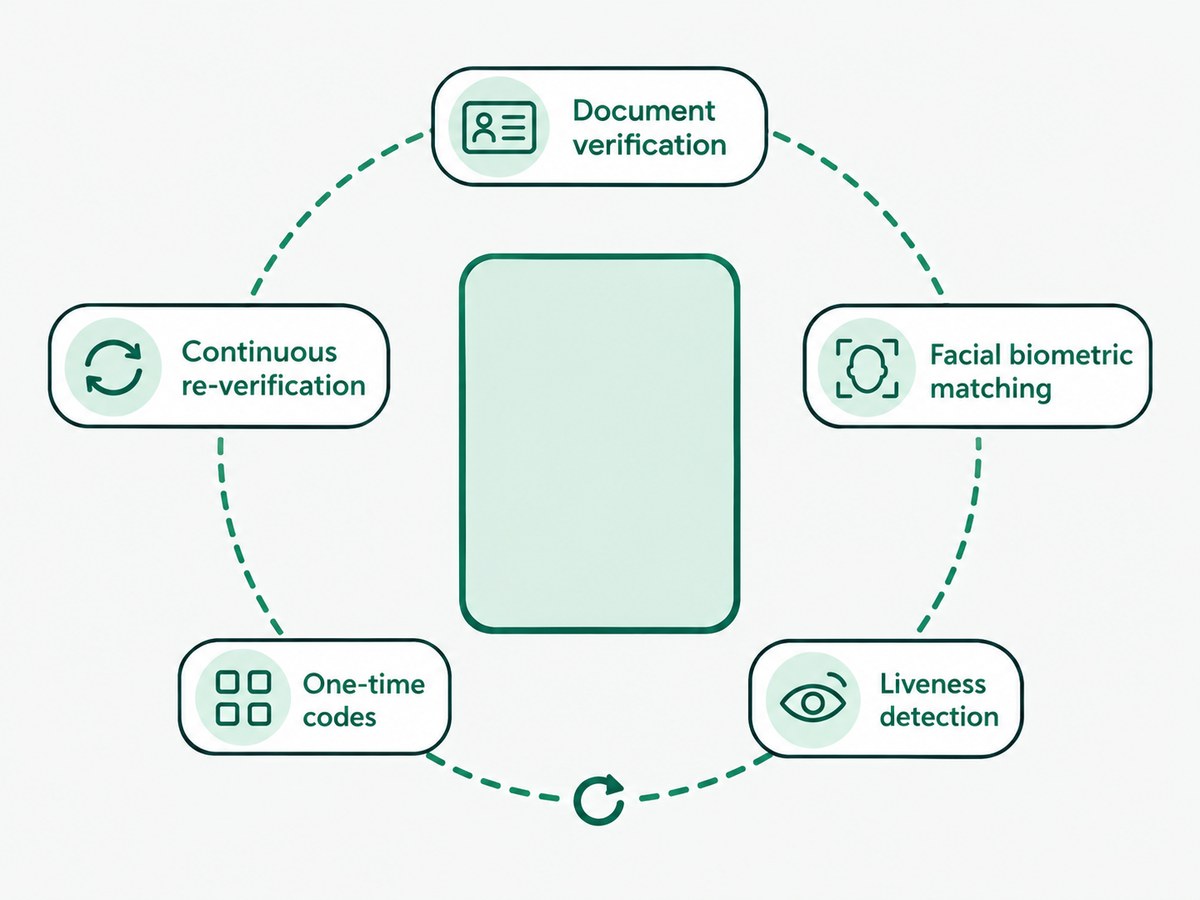
- Document verification - the candidate scans or photographs a government-issued ID, which is checked against registration records
- Facial biometric matching - a live photo or short video is compared against the submitted ID and, ideally, a previously verified reference photo
- Liveness detection - the system prompts an action (a blink, a head turn) to confirm a real, present person rather than a static photo, mask, or pre-recorded video being used to spoof the check
- One-time codes or credentials - a code sent to a registered email or phone ties exam access to something only the actual candidate should be able to receive
- Continuous or periodic re-verification - rather than checking once at login, the system re-confirms identity at intervals throughout the exam, catching substitution attempts that happen after the initial check
No single method fully solves the problem alone - document verification catches a different failure mode than liveness detection does, which is why combining several is the standard approach for anything above low-stakes.
Calibrate Verification Rigor to the Credential's Stakes
Not every exam needs the same level of verification, and over-verifying a low-stakes assessment creates friction without a matching benefit.
- High-stakes, professionally significant credentials (licensure, safety-critical certifications) warrant multiple layered methods, document verification, biometric matching, liveness detection, and continuous re-checks throughout the session
- Mid-stakes professional certifications often do well with a strong initial check (photo ID plus a live selfie match) combined with at least one periodic re-check during longer exams
- Lower-stakes internal certifications may reasonably use a lighter approach, a unique login plus a one-time code, without the full biometric layer
- Document why you chose a given rigor level for a given credential, since this reasoning is part of what makes your certification program defensible if a result is ever challenged
The right question isn't "what's the most secure verification method available", it's "what level of assurance does this specific credential actually require."
Watch for Newer Impersonation Threats
Verification technology and impersonation tactics are both evolving, and it's worth being aware of where the newer risk is concentrated.
- Deepfake and synthetic media risks are an emerging concern for verification systems, since a convincing manipulated video or image can potentially fool a check that only looks for a live human face without deeper liveness or anti-spoofing analysis
- Anti-spoofing checks - looking for signs of a mask, a photo held up to a camera, or manipulated video are increasingly important alongside basic facial matching, not a replacement for it
- This is an active area of development, not a fully solved problem - verification vendors continue updating their methods as impersonation tactics evolve, and a certification program's verification approach should be reviewed periodically rather than set once and left unchanged
Treat this as a reason to periodically reassess your verification approach, not as a reason to distrust the category of biometric verification altogether - the underlying methods remain a meaningful improvement over login-only verification even as they continue to be refined.
Build Verification Into the Workflow, Not as an Add-On
Verification works best when it's a native part of the exam flow, rather than a separate manual process your team has to manage alongside the actual test.
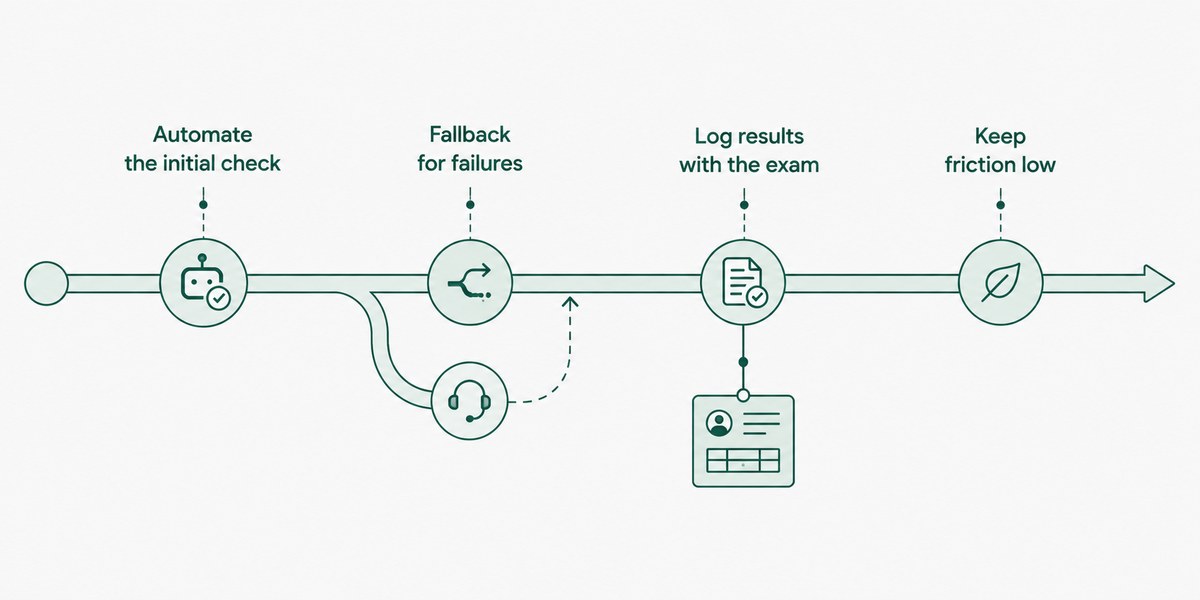
- Automate the initial check wherever possible, so identity confirmation doesn't depend on a staff member manually reviewing every candidate before granting access
- Have a fallback process for verification failures - a legitimate candidate who fails an automated check (poor lighting, an ID scan issue) needs a manual review path rather than automatic disqualification
- Log verification results alongside exam results, since the identity confirmation record is part of the auditable trail behind a credential
- Keep the process as low-friction as reasonably possible for legitimate candidates, since excessive verification friction can itself become a barrier for candidates with disabilities or limited technology access
TunnelQuiz builds email OTP verification into the exam flow, and from the Essential plan adds a check-in photo and a webcam still every minute, so the evidence of who sat the exam is collected automatically rather than as a separate step your team manages manually. For certification programs needing this built into the actual exam delivery, TunnelQuiz's identity verification features cover the login-and-photo layer directly.
The Short Version
Verifying candidates during an online exam works best as a layered process, document checks, biometric matching, and liveness detection combined rather than relying on a single method, with rigor calibrated to what a specific credential actually requires. Newer threats like deepfakes are pushing verification methods to keep evolving, which means this is an area worth revisiting periodically rather than treating as a solved, static checklist.
Frequently asked questions
What is the most secure way to verify a candidate's identity in an online exam?
A layered approach combining document verification, live photo matching, and liveness detection provides stronger assurance than any single method alone, since each addresses a different way identity checks can be spoofed. For high-stakes credentials, continuous or periodic re-verification throughout the exam adds further protection against mid-exam substitution.
Is a login and password enough to verify a candidate?
Generally, no, for anything above low-stakes assessments, login credentials confirm access but not identity, since they can be shared or compromised without the actual registered candidate's involvement. Most certification-level verification pairs login access with at least one additional method, such as a photo match or one-time code.
How does facial recognition work for exam verification?
The system captures a live photo or short video of the candidate and compares it against their submitted ID and, in many systems, a previously verified reference photo, using facial matching technology to confirm a likely match. Liveness detection is typically paired with this to confirm the image is a real, present person rather than a photo or recording.
Can identity verification be fooled with a deepfake?
It's a genuine and growing concern, which is why anti-spoofing and liveness detection - checking for signs of a real, present person through prompted actions or depth analysis - are increasingly built into verification systems alongside basic facial matching. This remains an active area of development rather than something fully solved by any current method.
What should happen if a candidate fails identity verification?
A legitimate candidate who fails an automated check due to a technical issue, such as poor lighting or an ID scan problem, should have access to a manual review path rather than automatic disqualification. Programs should document how verification failures are handled as part of building a fair and defensible process.