Are online proctored exams secure?
Security depends on the vendor's data handling, the fairness of its models and how the institution implements it. The three questions worth asking before you buy.
In short
Data privacy, algorithmic fairness and technical exploitability. None are solved industry-wide, which is why vendor selection matters more than the general question.
Online proctored exams can be secure, but security isn't a fixed property of the category - it depends entirely on how a specific vendor handles data encryption, storage, retention, and compliance, and how transparently an institution communicates that to test-takers. The honest answer to "is online proctoring secure" is closer to "it depends on the implementation" than a simple yes or no, and treating it as a blanket guarantee is where a lot of institutions get into trouble.
This article breaks down what "secure" actually means in this context, the technical protections in place, the real privacy trade-offs, and the questions worth asking before trusting a platform with sensitive biometric and behavioral data.
What "Secure" Actually Covers
When people ask if proctored exams are secure, they're usually asking about several distinct things at once, and it's worth separating them:
- Data security - is the video, audio, and ID data encrypted in transit and at rest, and who can actually access it?
- Exam integrity security - does the lockdown browser and monitoring actually prevent cheating, or can it be bypassed?
- Algorithmic fairness - does detection perform consistently across different appearances, accents, lighting conditions, and disabilities?
- Regulatory compliance - does the platform meet the legal data-protection standards that apply to the institution and its students?
A platform can be strong on one of these and weak on another. "Secure" as a single word tends to flatten four genuinely different questions into one, which is exactly why vague marketing claims about security are worth pushing past.
The Technical Protections Most Legitimate Platforms Use
Reputable proctoring vendors generally implement a consistent set of technical safeguards, even though the specifics vary:
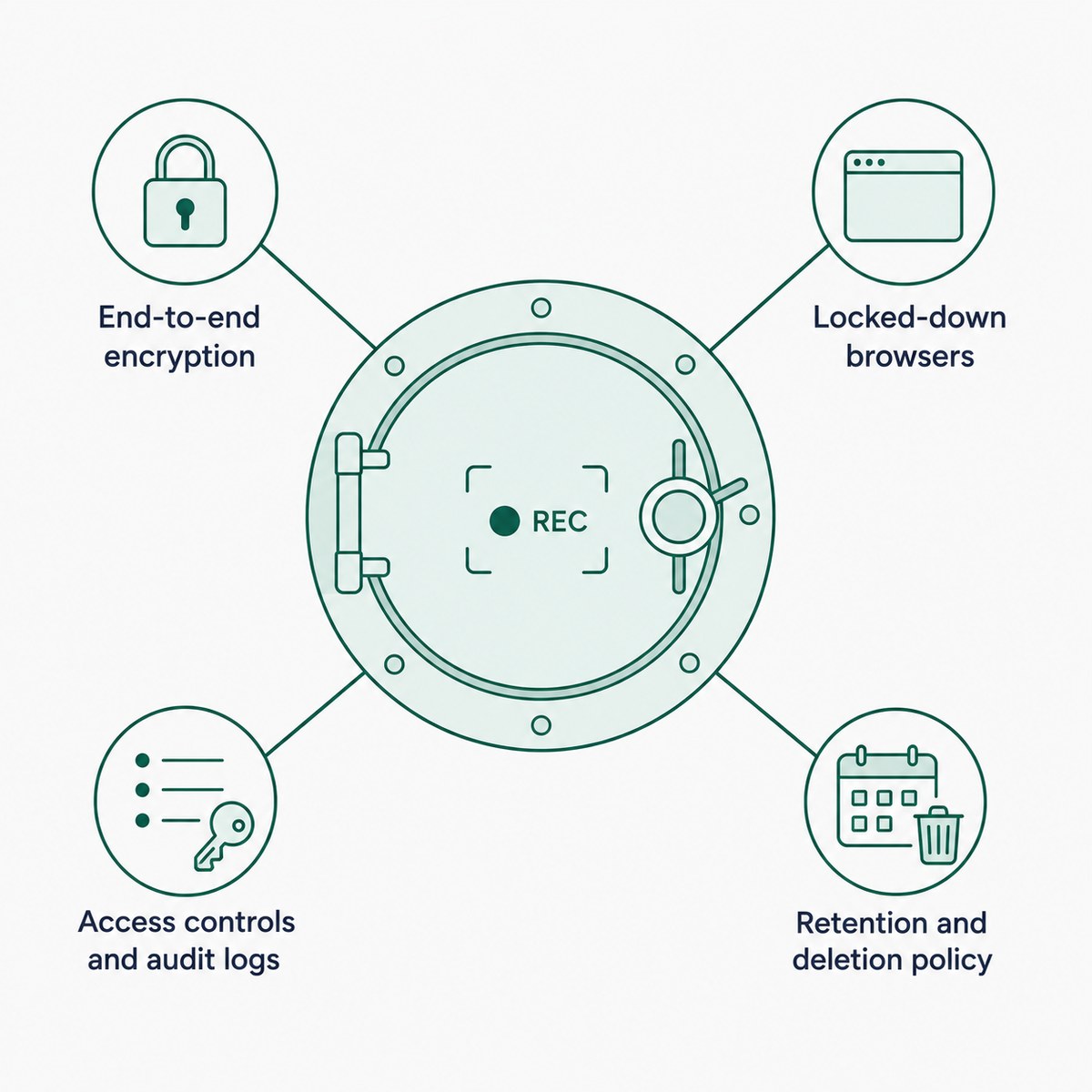
- End-to-end encryption for video, audio, and identity data both while it's being transmitted and while it's stored
- Secure, locked-down browsers that restrict access to other applications and prevent the exam interface itself from being copied, screenshotted, or manipulated
- Access controls and audit logs limiting which staff can view recorded sessions, and logging when they do
- Defined data retention and deletion policies, so recordings aren't kept indefinitely once the review period ends
None of this is exotic technology - it's largely standard practice borrowed from other industries that handle sensitive personal data. The differentiator between vendors is usually how strictly these practices are actually enforced, not whether they exist on paper.
Compliance Frameworks That Matter
For institutions in the U.S. and Europe specifically, two regulatory frameworks come up constantly in proctoring vendor evaluations:
- FERPA (Family Educational Rights and Privacy Act) - governs how U.S. educational institutions handle student education records, including exam data
- GDPR (General Data Protection Regulation) - applies to any platform handling data belonging to EU residents, with strict rules around consent, data minimization, and the right to deletion
Compliance with these frameworks isn't optional for institutions operating in the relevant jurisdictions, and it's a reasonable, concrete question to ask any vendor directly rather than assuming it's covered.
Privacy Concerns Are Legitimate, Not Overblown
It's worth taking this seriously rather than treating student privacy concerns as an overreaction. Being recorded via webcam and microphone inside your own home is a genuinely different experience than sitting in a classroom, and the concerns that come with it are reasonable:
- Environmental exposure - a room scan reveals details about someone's living situation that have nothing to do with the exam
- Anxiety - being watched, even by software, measurably adds stress for some test-takers on top of the exam itself
- Discrimination risk - appearance, background noise, or environmental factors outside a student's control can influence what gets flagged
- Third-party access - in some cases, vendor staff may need to access recordings for technical troubleshooting, which raises its own data-handling questions
Industry research using contextual privacy frameworks has found that how acceptable proctoring feels to students varies a lot depending on exactly what data is collected, who sees it, and why, not just whether monitoring happens at all. That nuance is useful: it suggests transparency and scope, not just the presence or absence of proctoring, is what actually drives whether students trust the process.
Adoption Has Grown Faster Than Regulation in Some Cases
Online proctoring adoption expanded rapidly over the past several years - industry data from testing providers shows online proctoring going from a small fraction of total test deliveries before 2020 to roughly a third of deliveries by 2023. That kind of rapid growth, much of it accelerated by the shift to remote learning, meant some institutions adopted proctoring tools quickly without fully evaluating vendor data practices first.
This is part of why due diligence matters more now than it might have a few years ago - institutions revisiting or newly evaluating a proctoring vendor today have far more precedent, comparison points, and student feedback to draw on than early adopters did.
Questions Worth Asking Before Trusting a Platform
Whether you're a student wondering how your data will be handled or an administrator evaluating a vendor, a few concrete questions cut through most of the ambiguity:
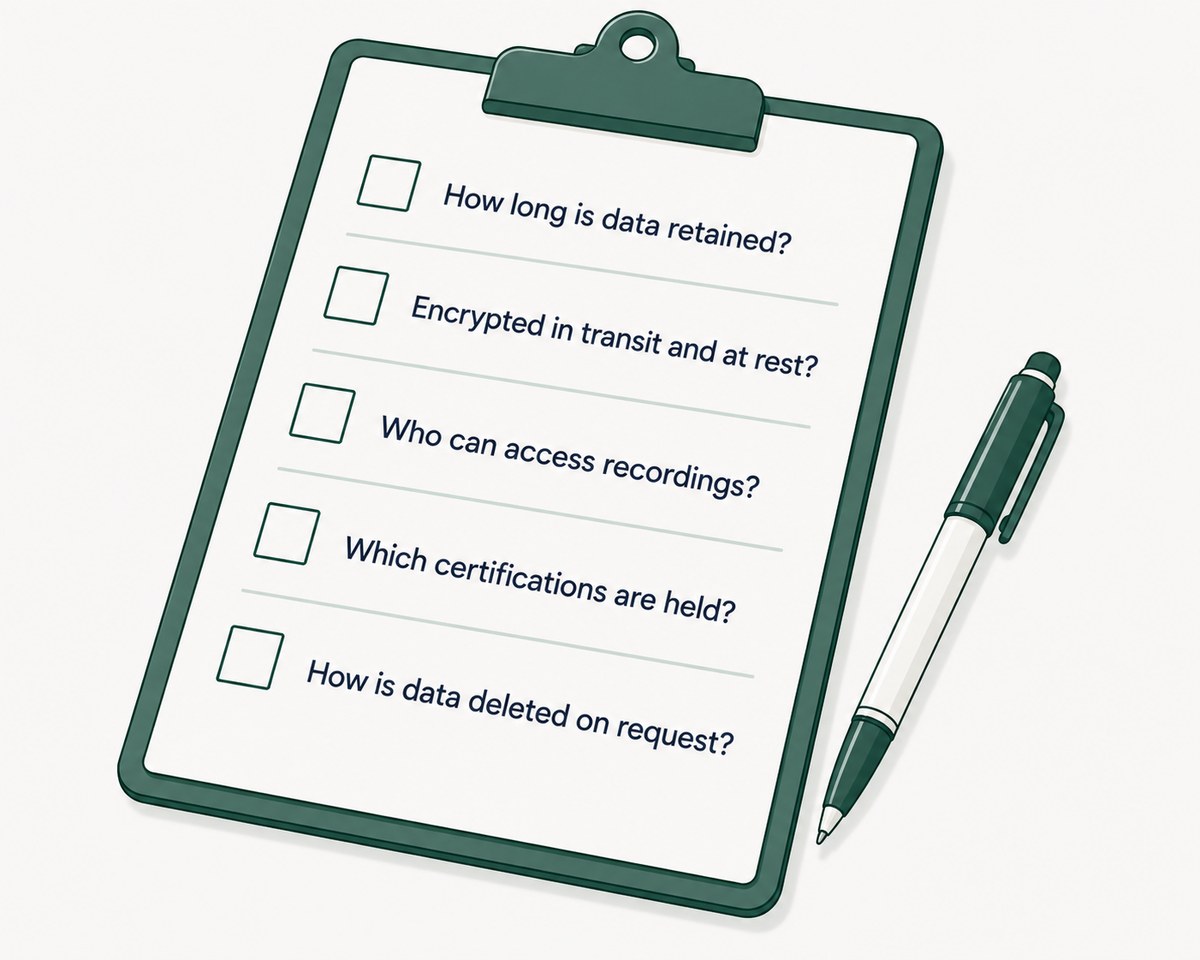
- How long is recorded data retained after the exam, and is that period disclosed clearly?
- Is data encrypted both in transit and at rest, not just one or the other?
- Which staff can access recordings, and is that access logged?
- What compliance certifications (FERPA, GDPR, SOC 2, etc.) does the vendor actually hold, versus simply claiming?
- Is there a documented process for deleting a student's data on request?
A vendor that answers these clearly and specifically is a very different proposition than one that responds with general reassurance and no documentation. TunnelQuiz publishes its data retention and deletion policy directly rather than leaving it to a support inquiry, specifically because these questions come up in nearly every institutional evaluation.
Security Also Means the Detection Working Correctly
Separate from data handling, "secure" also means the monitoring itself is doing its job accurately, not generating so many false positives that real review capacity gets overwhelmed, and not missing genuine violations because of weak detection. For the technical detail on how that detection actually works, read How Does AI Proctoring Detect Cheating?
The Short Version
Online proctored exams can be secure, but security depends on the specific vendor's encryption, data retention, access controls, and compliance certifications, not on the category of "online proctoring" as a whole. Privacy concerns from students are legitimate and worth taking seriously, and the due-diligence questions in this article are a reasonable starting point whether you're a student or an administrator. For the rest of the proctoring cluster, including detection technology and best practices, our complete guide to online exam proctoring covers it all.
Frequently asked questions
Is my personal data safe during an online proctored exam?
It depends on the specific vendor's practices, but reputable platforms use end-to-end encryption, defined retention periods, and access controls to protect video, audio, and identity data. It's reasonable to ask any institution or vendor directly what their specific data handling policy is rather than assuming.
Do online proctoring companies sell student data?
Legitimate, compliant vendors do not sell student data - data collected during proctoring is meant to be used solely for exam integrity purposes and typically deleted after a defined retention period. This should be explicitly stated in a vendor's privacy policy, and it's worth confirming rather than assuming.
Can online proctoring recordings be hacked or leaked?
Like any system handling sensitive data, proctoring platforms carry some inherent risk, which is exactly why encryption, access controls, and strict retention limits matter so much. No system can claim to be completely risk-free, but strong technical safeguards significantly reduce the exposure.
Are online proctored exams GDPR and FERPA compliant?
Compliance varies by vendor and isn't automatic just because a platform operates in the U.S. or Europe - institutions should confirm a vendor's specific compliance certifications rather than assume coverage. This is one of the most important due-diligence questions in vendor selection.
Is it safe to do a room scan for a proctored exam?
Room scans are widely used, but they do reveal details about a test-taker's living space, which is why some institutions have scaled back or eliminated this specific practice in response to privacy concerns. If you're uncomfortable with a room scan, it's worth checking whether your institution offers any alternative or accommodation.