How to proctor certification exams online
Proctoring a credential calls for a different calibration than a classroom quiz, because the cost of a false certification is much higher than an inflated grade.
In short
Match rigour to what the credential unlocks, and document the methodology, certifying bodies get asked to explain how a result was secured.
Proctoring a certification exam online means choosing a monitoring model - live, AI-based, recorded, or a hybrid of these - that's proportionate to what the credential unlocks, and documenting that choice well enough to defend it if a result is ever formally challenged. The proctoring decision for a certification exam isn't really a technology choice first; it's a risk and defensibility decision that happens to be implemented through technology.
This guide covers how to choose and implement proctoring specifically for certification-level stakes. For the broader certification exam lifecycle, see our complete guide to online certification exams.
The Proctoring Models and When Each Fits
Certification programs typically choose from four broad proctoring models, each with a different trade-off between cost, scalability, and assurance.
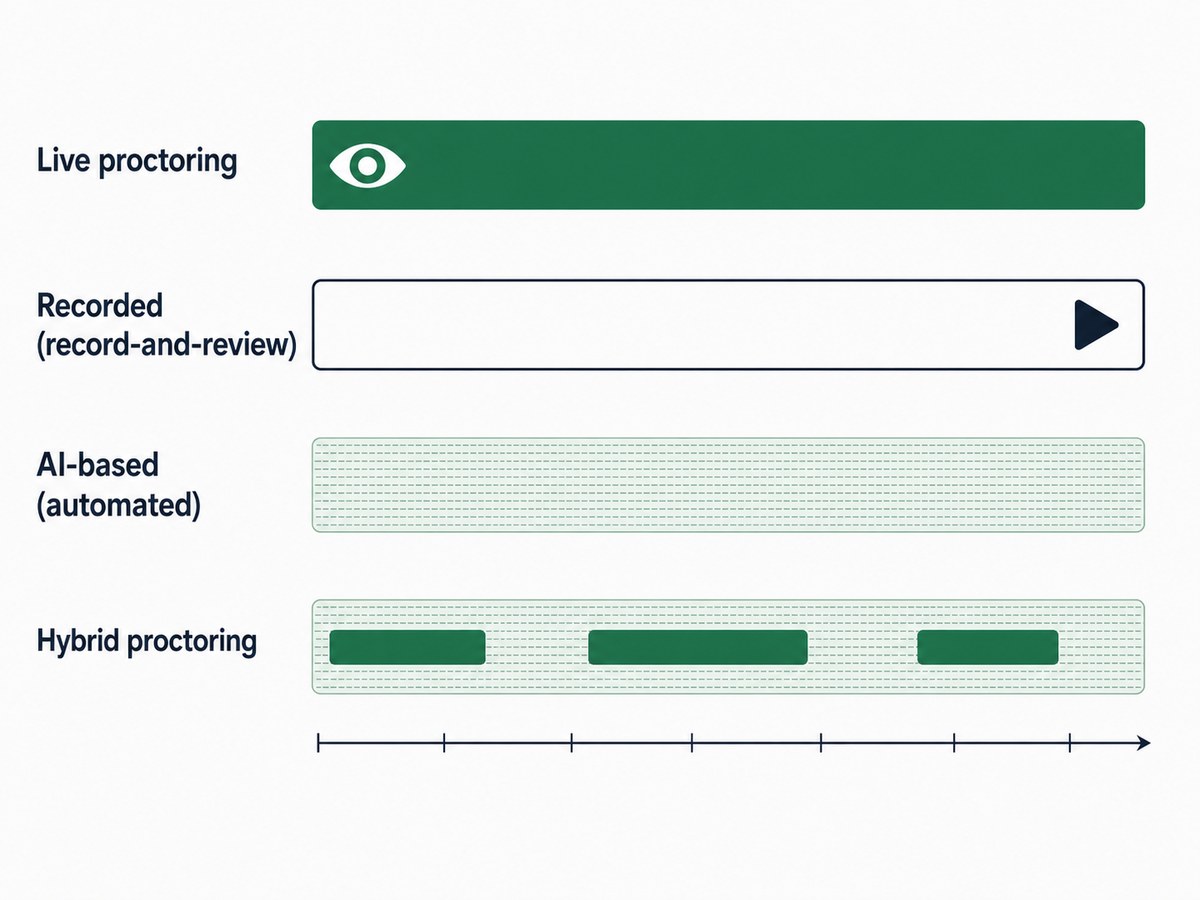
- Live proctoring - a trained human proctor watches the exam session in real time and can intervene immediately; this is the model exams like the CPA and bar exam rely on, where real-time security and defensibility matter more than convenience
- Recorded (record-and-review) proctoring - the full session is recorded and reviewed afterward, either for every candidate or only when something is flagged; this supports an on-demand testing window rather than a scheduled appointment, which matters for candidates with irregular schedules
- AI-based (automated) proctoring - software analyzes the session continuously and flags anomalies for review, scaling to large candidate volumes at much lower cost than live proctoring
- Hybrid proctoring - AI monitors continuously and automatically escalates flagged sessions to a human reviewer, combining AI's scale with a human's judgment on anything ambiguous
Hybrid proctoring has increasingly become the practical default for high-stakes certification exams specifically, because it balances cost and scale against the legal defensibility a pure AI-only approach can struggle to provide on its own.
Match Proctoring Rigor to What the Credential Unlocks
Not every certification carries the same stakes, and treating them all identically either overspends on low-stakes credentials or under-protects high-stakes ones.
- High-stakes, legally or professionally significant credentials (licensure, safety-critical certifications) generally warrant live or hybrid proctoring, where real-time intervention and strong defensibility matter most
- Mid-stakes professional certifications often do well with hybrid or AI-based proctoring, where scale matters but the consequences of a rare false negative are lower than for a license
- Lower-stakes internal or entry-level certifications may reasonably use lighter AI monitoring or even none at all, if the credential's real-world impact is limited
- Document the reasoning behind your choice, not just the choice itself - being able to explain why a given proctoring model was appropriate for a given credential is part of what makes the overall program defensible
This calibration decision matters more than which specific vendor or technology you choose - a mismatched proctoring model, either too light or unnecessarily heavy, creates its own risk.
Build a Defensible Audit Trail, Not Just a Flag
A recurring theme in certification proctoring is that an AI flag alone isn't a defensible answer if a result is ever formally challenged - "the algorithm flagged it" doesn't hold up the way a documented human review process does.
- Ensure every flagged session gets a documented human review, with the reviewer's reasoning recorded, not just the flag itself
- Retain the underlying session data (recording, flag log, reviewer notes) for a defined retention period tied to how long the credential remains valid
- Standardize your review criteria across reviewers, so two different people evaluating the same flagged behavior would reach similar conclusions
- Treat the audit trail as part of the credential's value, not an administrative afterthought - it's what lets your certification hold up if it's ever questioned by an employer, a regulator, or the candidate themselves
The deeper technical mechanics of how AI flagging actually works, what specific behaviors get detected, and how it works are covered in full in our proctoring cluster; see How Does AI Proctoring Detect Cheating? for that depth. What matters at the certification-program level is less how the detection works and more whether your review and documentation process around it would survive scrutiny.
Prepare Candidates and Reduce Avoidable Failures
The most common proctoring problems in certification exams usually aren't about cheating at all - they're technical failures at check-in that could have been prevented with better preparation.
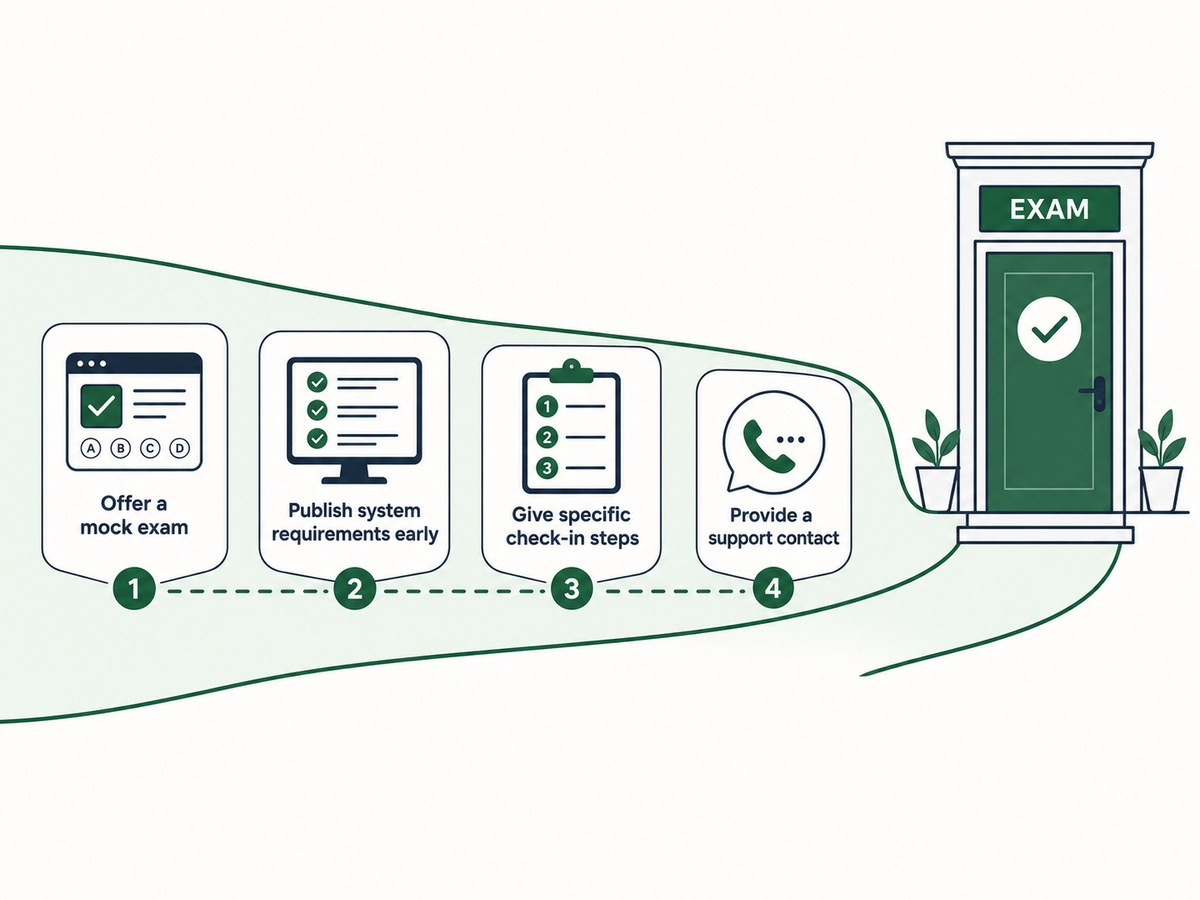
- Offer a mock exam or system check using the actual proctoring platform before the real exam, so candidates can troubleshoot browser, camera, and connectivity issues in advance
- Publish clear system requirements well ahead of the exam window - outdated browsers, unstable connections, and locked-down work computers are consistently reported as the most common check-in failure points, not exam content itself
- Provide clear, specific check-in instructions, since the identity verification and environment check at the start of a proctored session is where most first-time candidates get tripped up
- Give candidates a support contact for exam-day technical issues, since a candidate stuck at check-in with no way to reach anyone loses real exam time through no fault of their own
TunnelQuiz's live monitoring option (from Essential) and browser-based, no-install format remove one of the most common friction points directly - candidates don't need to download or configure separate proctoring software before check-in, which cuts down on a meaningful share of avoidable technical failures.
Train Everyone Involved, Not Just the Candidates
Proctoring failures aren't always on the candidate's side - examiners and reviewers need real familiarity with the platform too.
- Train reviewers on the monitoring dashboard and flagging system before a live exam window, not on the fly during one
- Walk administrators through the full flag-to-resolution workflow, so there's no ambiguity about who reviews what and how a decision gets documented
- Communicate exam rules and proctoring expectations to candidates clearly in advance, including what the check-in process will actually involve
- Run a full dry cycle internally - mock candidates, mock flags, mock review - before the first real exam window, the same discipline you'd apply to piloting the exam content itself
A proctoring program that's well-rehearsed on the administrative side produces far fewer disputes than one where the technology works but the humans running it are improvising.
The Short Version
Proctoring a certification exam online comes down to choosing a monitoring model proportionate to the credential's stakes, backing it with a genuinely documented human review process rather than relying on a flag alone, and preparing candidates and staff well enough that technical friction, not cheating, doesn't become the biggest problem on exam day.
If you're setting this up, TunnelQuiz's browser-based, no-install format and live monitoring option (from Essential) remove common check-in friction points directly, letting candidates get into the exam without a separate software installation step to troubleshoot.
Frequently asked questions
What's the best proctoring method for a certification exam?
It depends on the credential's stakes - high-stakes, legally significant credentials generally warrant live or hybrid proctoring, while mid- and lower-stakes certifications can often use AI-based or lighter monitoring. Hybrid proctoring, combining AI monitoring with mandatory human review of flags, has become a common default for balancing cost, scale, and defensibility.
Is AI proctoring alone enough for a certification exam?
For lower-stakes credentials, it can be sufficient, but for high-stakes certifications, relying on AI flags without mandatory human review creates a defensibility gap if a result is ever formally challenged. "The algorithm flagged it" generally isn't treated as a sufficient explanation on its own; a documented human review process behind the flag matters.
What's the most common problem in online certification exam proctoring?
Technical check-in failures, outdated browsers, unstable internet, or locked-down work computers are consistently reported as a bigger practical problem than actual cheating attempts. A mock exam or system check before the real exam significantly reduces this category of failure.
How long should certification exam recordings and flag data be retained?
Retention should be tied to how long the credential itself remains valid or how far back a challenge could reasonably occur, rather than a fixed universal timeframe. This is a policy decision each certifying body needs to set explicitly rather than leaving it to a vendor's default setting.
Can a certification body use different proctoring levels for different exams?
Yes, and it's generally the right approach, matching proctoring rigor to each specific credential's stakes, rather than applying one uniform standard across every exam a program offers, avoids both overspending on low-stakes exams and under-protecting high-stakes ones. Documenting the reasoning behind each choice is part of what keeps the overall program defensible.