How to prevent cheating in online exams
Proctoring software is one layer of exam integrity, not the whole strategy. Five practices that reduce both cheating and disputes.
In short
Institutions that lean on software alone see more disputes and more anxiety. What works is pairing the technology with better exam design.
Preventing cheating in online exams comes down to three layers working together: designing exams that are harder to cheat on in the first place, using proctoring technology to catch and deter misconduct, and setting clear expectations so students understand what's allowed before they ever start the test. No single layer catches everything on its own - institutions that rely only on software tend to see more disputes, and institutions that rely only on policy tend to see more actual cheating.
This article walks through practical strategies across all three layers, in plain terms you can actually implement. For the technology piece specifically, how AI and proctoring software work, see our complete guide to online exam proctoring.
Start With Exam Design, Not Just Software
The single most overlooked lever in preventing cheating isn't a monitoring tool - it's how the exam itself is built. A well-designed exam removes a lot of the incentive and opportunity to cheat before a single camera turns on.
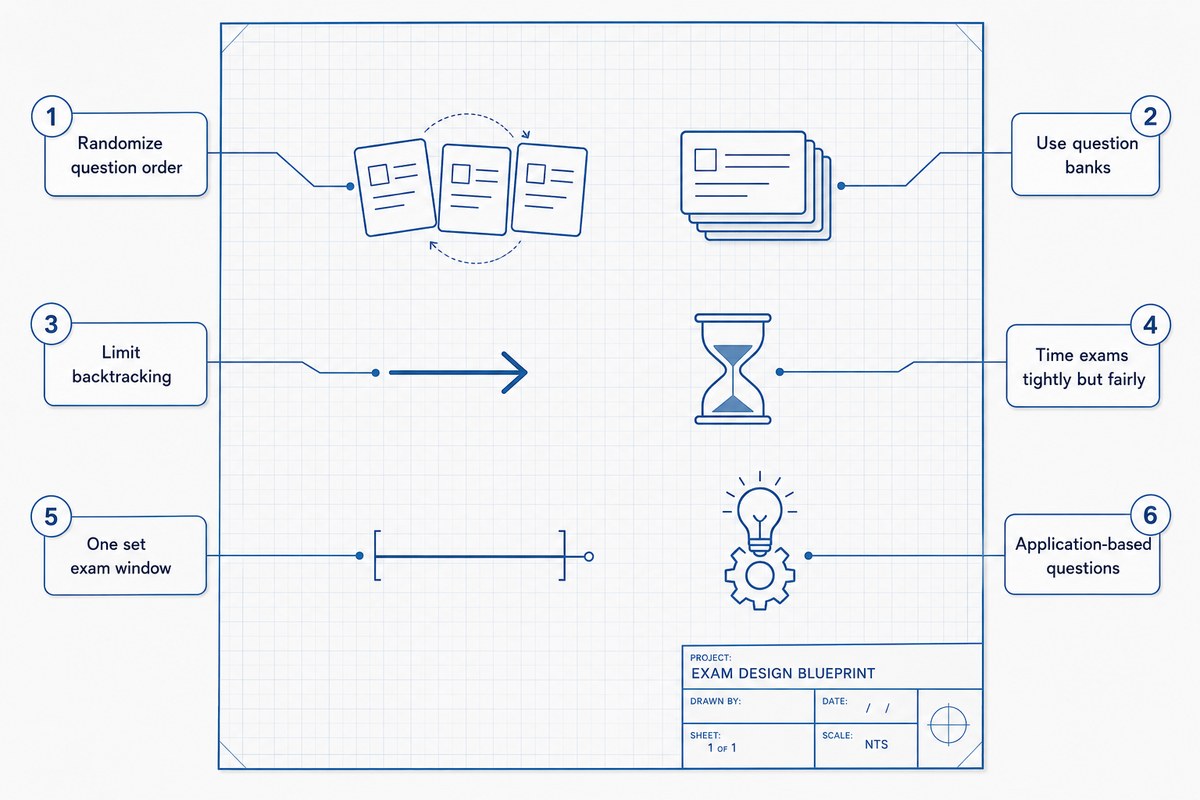
- Randomize question order and answer choices - makes it much harder for students to share answers by position ("number 4 is B") even if they're communicating during the exam
- Use question banks - pull from a larger pool so each student gets a different, comparable-difficulty version rather than the identical test
- Limit backtracking - presenting one question at a time without the ability to return prevents students from using leftover time at the end to search for earlier answers
- Time exams tightly but fairly - enough time to demonstrate knowledge, not enough to comfortably look everything up
- Offer the exam in one set window - rather than leaving it open for days, which prevents students from coordinating and taking it sequentially to share answers
- Favor application-based questions over pure recall - questions that require reasoning through a scenario are harder to look up verbatim than fact-recall questions
None of this requires proctoring software at all. It's exam architecture, and it works whether or not you're also using monitoring technology.
Layer In Proctoring Technology
Once the exam itself is harder to cheat on, technology closes the remaining gaps, verifying who's taking the exam and catching behavior that exam design alone can't prevent.
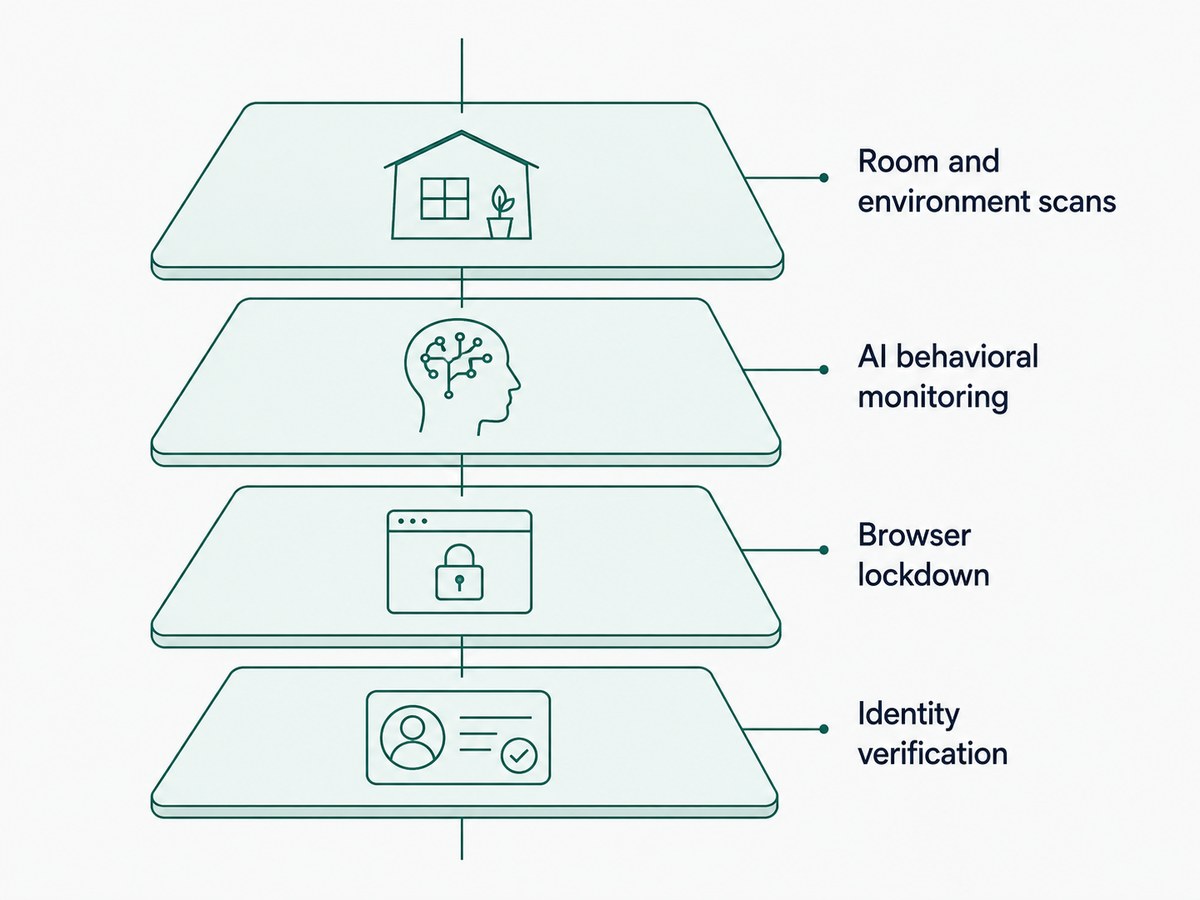
- Identity verification - an ID scan and photo match confirm the right student is actually taking the exam
- Browser lockdown - restricts access to other tabs, applications, and keyboard shortcuts during the test, which is foundational even if you use nothing else
- AI behavioral monitoring - flags unusual patterns like repeated glances away from the screen, a second voice, or an unrecognized face entering frame
- Room or environment scans - a quick camera pan can catch notes or unauthorized materials before the exam starts
Hybrid setups, where AI handles continuous monitoring and a human proctor only steps in when something is actually flagged, tend to strike the best balance between catching genuine issues and not treating every innocent movement as suspicious. For the technical detail on exactly how this detection works, read How Does AI Proctoring Detect Cheating? And if you want to understand the two specific behaviors institutions ask about most, see how systems catch a second connected screen and how tab switching gets logged.
Set Clear Expectations Before Exam Day
A meaningful share of academic dishonesty cases come down to genuine confusion about what's actually allowed, not deliberate rule-breaking. Clear communication closes that gap.
- State the rules explicitly - what materials are permitted, what counts as unauthorized help, and what the consequences are for violations
- Have students acknowledge an academic integrity policy before the exam, even something as simple as a checkbox confirming they've read it
- Explain what the proctoring software will actually monitor - a room scan, browser lockdown, webcam - so nothing feels like a surprise or a hidden trap
- Offer a practice run with the same proctoring setup before the real exam, so students aren't troubleshooting unfamiliar technology under exam pressure
- Address exam-related anxiety directly - students under high stress are more likely to consider cheating as a way to avoid failing, so reducing unnecessary pressure (clear time limits, no ambiguous instructions) is itself a form of prevention
This layer costs nothing technologically and consistently reduces disputes, because students who understand the process tend to trust it more.
Prevention Also Means Handling Flags Fairly
Prevention isn't just about stopping cheating before it happens - it's also about how you handle the moments that get flagged. A program that treats every AI flag as an automatic accusation creates its own problems: stressed, wrongly accused students, appeals processes clogged with false positives, and eroded trust in the system overall.
- Route every flag through human review before any consequence is applied
- Give students a real appeals process, not just a support ticket that disappears into a queue
- Train reviewers on what a false positive typically looks like - poor lighting, pets, disability-related movement - so they're not treating every flag identically
This is a principle TunnelQuiz builds into its exam design guidance for institutions: prevention isn't just about the technology catching more - it's about the whole process being fair enough that students trust it and administrators can defend it.
A Newer Challenge: AI-Assisted Cheating
Exam design and proctoring strategies built for traditional cheating methods, hidden notes, a second person feeding answers - don't fully cover a newer category: students using AI chatbots or hidden desktop assistants to generate answers in real time. This is an evolving problem, and no single tactic solves it completely yet.
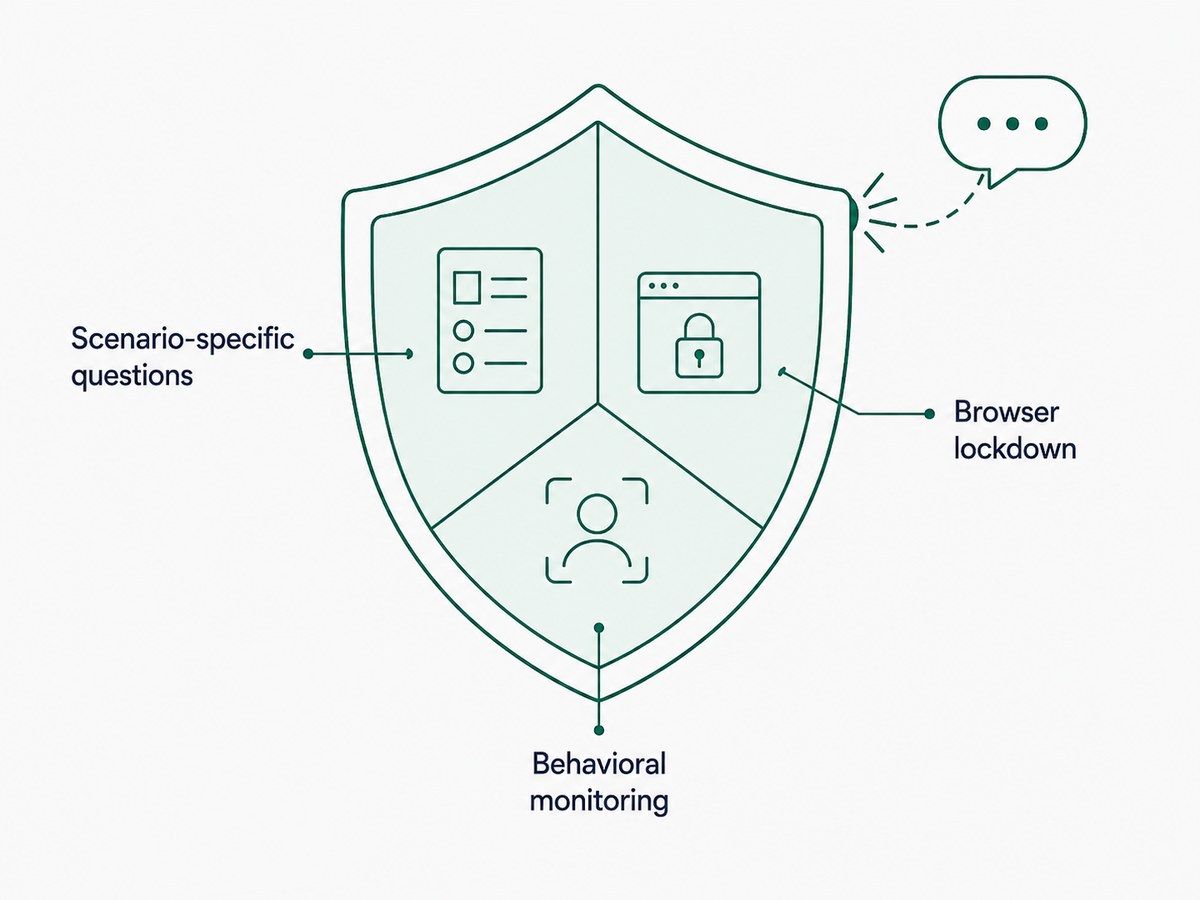
- Application-based and scenario-specific questions are harder for generic AI tools to answer convincingly than fact-recall questions
- Browser lockdown reduces (but doesn't eliminate) the ability to access external AI tools during the exam
- Behavioral monitoring is increasingly being trained to notice patterns associated with reading off-screen text or unusual response timing, though this remains one of the harder detection problems in the field
Treat this as an active area to keep watching rather than something you can fully solve with a one-time policy change.
Conclusion
Preventing cheating in online exams works best as a combination of smarter exam design, proctoring technology, and clear communication, not any single tactic alone. Handling flagged moments fairly matters just as much as catching them in the first place, and newer challenges like AI-assisted cheating mean this is an area to keep revisiting rather than solve once and move on from.
Frequently asked questions
What is the most effective way to prevent cheating in online exams?
No single method is fully effective on its own - the strongest approach combines exam design (randomized questions, limited backtracking), proctoring technology, and clear communication of expectations. Institutions that rely on only one layer tend to see either more cheating or more disputes.
Does browser lockdown software actually stop cheating?
Browser lockdown significantly reduces the ability to access outside resources during an exam, but it's a foundational layer, not a complete solution on its own. It works best paired with identity verification and behavioral monitoring rather than used in isolation.
Can randomizing exam questions really reduce cheating?
Yes, randomizing question order and using a larger question bank makes it much harder for students to share answers by position or take an identical test sequentially. It's one of the lowest-cost, highest-impact changes an instructor can make.
How do you prevent students from using AI chatbots to cheat?
There's no complete solution yet, but application-based questions that require reasoning through a specific scenario are harder for generic AI tools to answer convincingly than fact-recall questions. Combining this with browser lockdown and behavioral monitoring reduces, though doesn't eliminate, the risk.
Does exam anxiety actually increase cheating?
Research suggests a connection: students under high exam-related stress are more likely to view cheating as a way to avoid failing, which doesn't excuse the behavior but does mean reducing unnecessary pressure (clear instructions, fair time limits) is itself a prevention strategy. It's a different lever than technology, but a real one.