How to create an online assessment for recruitment
Build a test that predicts job performance: start from the job description, mix question types, set a real pass mark, and reuse it for every opening.
In short
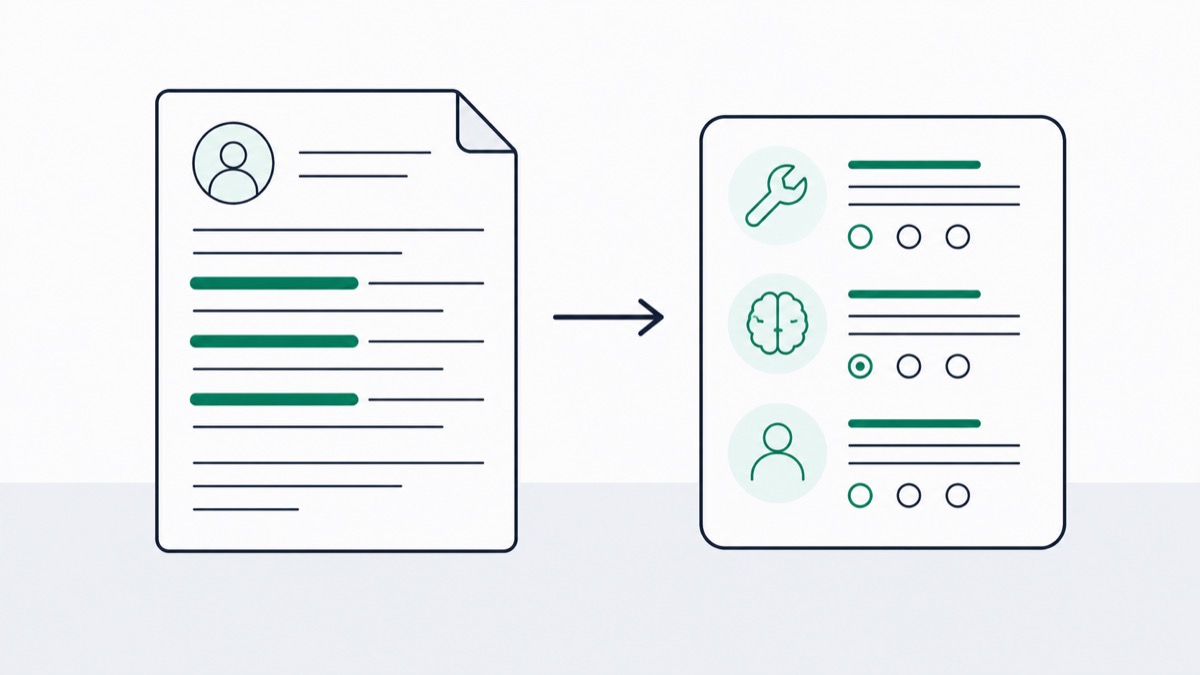
Start from the job description rather than a generic template. It makes the test better, and far easier to defend if anyone ever asks why a candidate was screened out.
Creating an online assessment for recruitment means defining what the job actually requires, choosing question types that measure it accurately, calibrating length and difficulty so candidates finish it, and testing it on a small group before rolling it out to real applicants. Done well, it takes a few focused hours, not weeks. The mistake most teams make isn't spending too little time; it's skipping steps and building from a generic template instead of the actual job.
This guide walks through that process in order, from defining what to measure through to scoring and follow-up.
Start With the Job, Not a Template
The single biggest predictor of whether a test is actually useful is whether it was built from the job description or borrowed from somewhere else and lightly edited.
- Pull the specific skills the role requires - not "problem-solving" in the abstract, but the actual tasks: debugging a specific type of error, calculating a specific kind of figure, applying a specific regulation
- Separate eligibility from suitability - eligibility is the baseline skill or knowledge someone needs to do the job at all; suitability is closer to fit, which a knowledge test measures poorly and shouldn't try to
- Loop in whoever will manage this person, not just the recruiter - a hiring manager usually knows the day-to-day tasks better than a job posting captures
- Write down what a passing score should actually indicate before you write a single question - "clears this bar and can reasonably do the job's core tasks" is a very different target than "scores in the top 20% of applicants"
Skipping this step is how teams end up with a test that's easy to build but doesn't predict much, and a test that doesn't predict anything is worse than no test, because it creates false confidence in a bad hire.
Choose the Right Question Types
Different question formats measure different things, and mixing them deliberately usually beats picking just one.
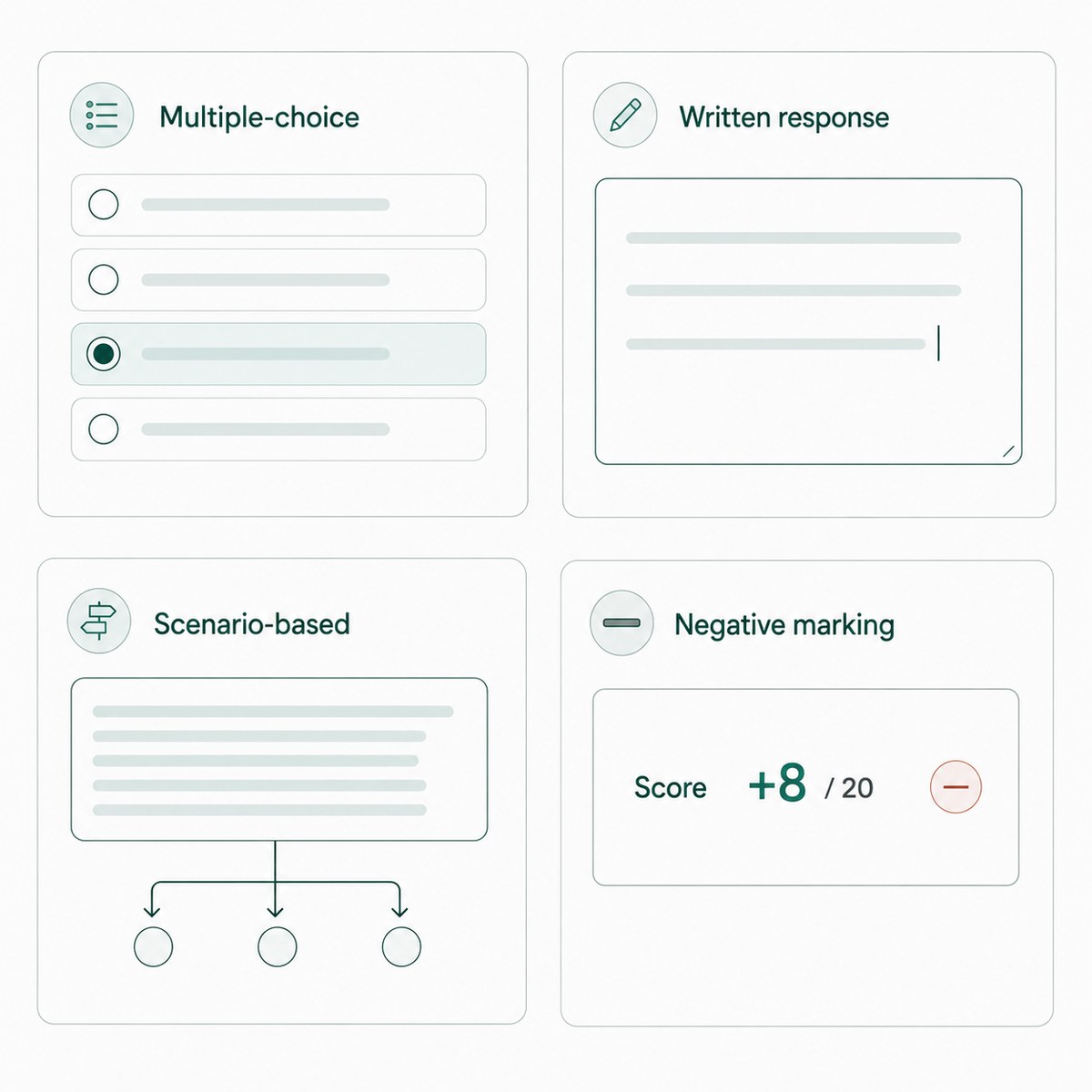
- Multiple-choice - fastest to build, grades instantly, works well for factual knowledge, concept checks, and scenario-based judgment questions with a clearly correct answer
- Written response - captures reasoning and explanation an MCQ can't, at the cost of needing a human or AI reviewer rather than instant grading
- Scenario-based questions - presenting a realistic situation and asking what the candidate would do tends to predict on-the-job behavior better than an abstract knowledge question
- Negative marking - worth using when guessing is a real risk (technical questions with plausible-sounding wrong answers), but calibrate it carefully so it doesn't punish reasonable uncertainty as harshly as a wild guess
Randomizing question order and answer options per candidate matters more than people expect, especially for any test that will be reused across multiple hiring cycles - a static test with a fixed order tends to circulate among candidates faster than teams realize. This is one of the more underrated features in a platform like TunnelQuiz, which shuffles both question and option order automatically per candidate.
Set the Right Difficulty, Length, and Pass Mark
A technically well-built test still fails if it's too long, too hard, or scored against an arbitrary number.
- Keep total time around 30-40 minutes as a general benchmark, long enough to measure something real, short enough that strong candidates don't drop off partway through
- Match difficulty to the actual bar, not to how impressive a low pass rate looks - a test that fails 90% of applicants for a role with reasonable requirements usually means the test is miscalibrated, not that the applicant pool is weak
- Set the pass mark before you see results, not after, to avoid unconsciously adjusting it to fit whoever happened to apply
- Separate "must-have" and "nice-to-have" skills in scoring, if the role has both, rather than weighting every question identically
For high-volume roles, a retail hiring drive, a BPO screening hundreds of applicants a week, length discipline matters even more, since drop-off compounds fast when hundreds of people are taking the same test.
Build for Scale and Reuse
A test built once and thrown away after a single hiring cycle wastes most of the effort that went into building it well.
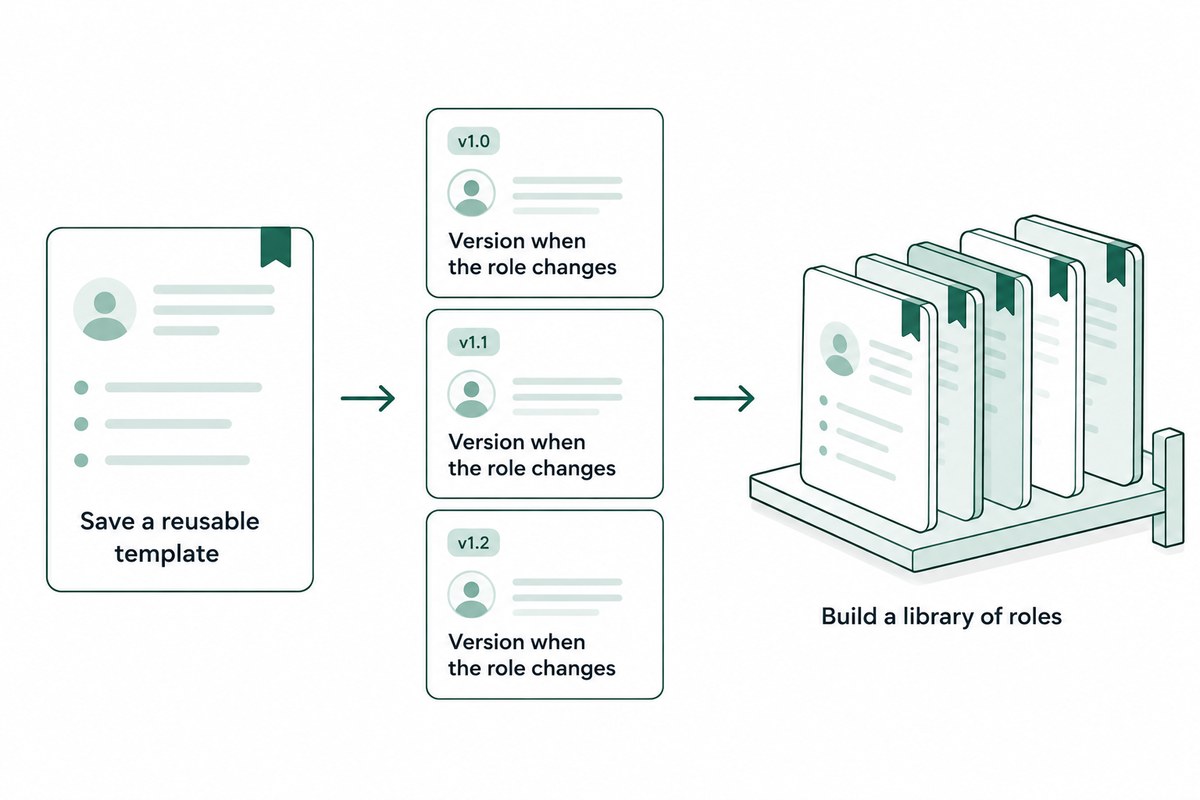
- Reuse a strong test for every future opening in the same role, rather than rebuilding from scratch each time
- Duplicate it and edit the copy when the role changes, instead of quietly editing the same test and losing track of what changed
- Build a small library across your most-hired roles, so new postings can start from something proven rather than a blank page
TunnelQuiz makes this simple - set a test up once, reuse it across every future opening for that role, and when the role evolves, duplicate it and adjust the copy without starting over or touching the original.
Pilot Before You Launch
Running a new test on real applicants without testing it first is how ambiguous questions and timing problems make it into a live hiring round.
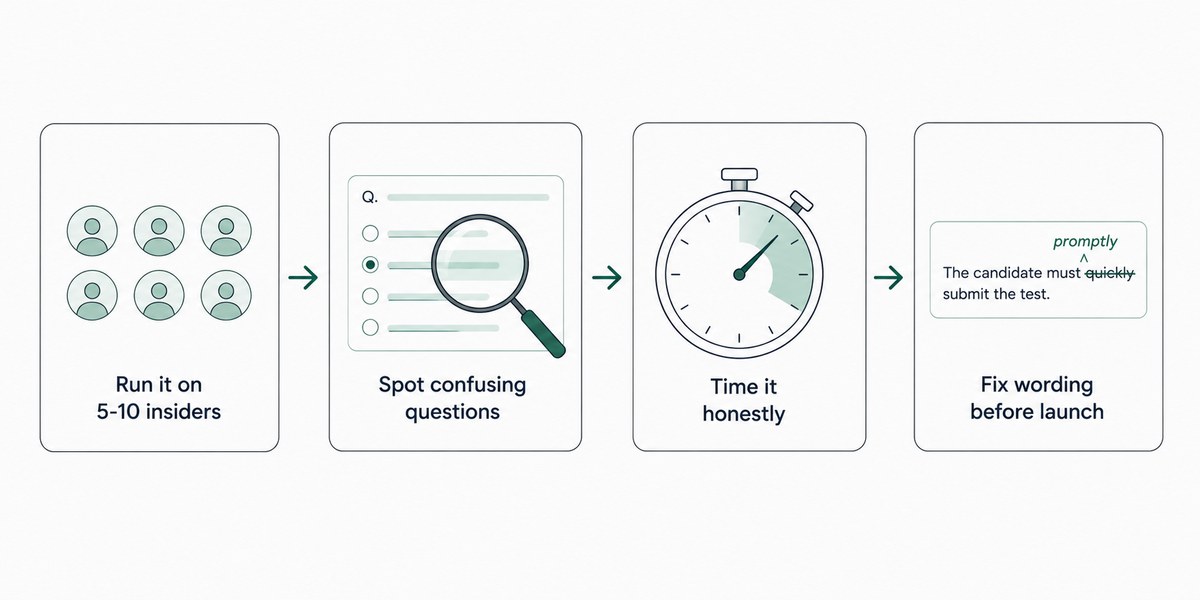
- Run it internally on 5-10 people who already do the job well, or are close enough to it, before it touches a single real candidate
- Check for questions that confuse strong performers - if someone good at the job gets a specific question wrong, the question is probably the problem, not the person
- Time it honestly, not on your own fast first pass through - have pilot testers take it at a normal, unhurried pace to get a realistic length estimate
- Fix ambiguous wording before launch, not after candidates start flagging it in feedback
This step gets skipped more than any other in the process, usually under time pressure, and it's the step most likely to save you from a test that quietly filters out good candidates for the wrong reasons.
Administer It Without Losing Good Candidates
A strong test can still lose good candidates if the experience of actually taking it is frustrating.
- Communicate clearly before the test - purpose, format, roughly how long it takes, and what happens next
- Avoid anything requiring a software install - a lockdown browser download or extension adds friction and drop-off, especially for candidates testing from shared, older, or work computers
- Make sure answers save automatically, so a dropped connection doesn't cost someone their progress or unfairly count against them
- Give a reasonable testing window, not a single fixed time slot, especially for remote or multi-timezone hiring
The logistics of remote administration deserve their own deeper treatment - for the full breakdown, read How to Assess Candidates Remotely
Protect the Results
A test result only means something if you can trust that the person who took it is who they claim to be, and that they took it honestly.
- Verify identity at the start, not just at the offer stage, so a score is tied to a real, specific person from the beginning
- Watch for behavior patterns that suggest outside help - repeated tab switching, a second device in view, or answers that don't match the reasoning shown elsewhere in the test
- Decide your risk tolerance by role - a high-stakes technical hire may warrant closer monitoring than a high-volume entry-level screen
This is a big enough topic to deserve its own full breakdown - see How to Reduce Cheating in Remote Hiring Tests for the complete approach, including what specific detection methods catch and what they miss.
Score, Follow Up, and Iterate
The test isn't done producing value once it's scored - what happens next determines whether it's actually improving your hiring process.
- Score consistently against the pass mark you set in advance, not case by case based on how you feel about a particular candidate
- Treat the result as one strong signal, not the whole decision - pair it with a structured interview rather than letting a score alone make the call
- Follow up with candidates promptly, even those who don't pass - a fast, respectful response protects your employer reputation more than people give it credit for
- Review question-level data after each hiring cycle - if a specific question is missed by almost everyone, including strong hires, it's probably a bad question, not a hard one
Over several hiring cycles, this feedback loop is what separates a test that keeps getting better from one that quietly becomes less useful the longer it goes unreviewed.
The Short Version
Creating an online assessment for recruitment works best as a sequence: define what the job actually requires, choose question types deliberately, calibrate length and difficulty, pilot it internally, administer it without losing candidates to friction, protect the results from cheating, and treat the score as one input among several rather than the whole decision. For the rest of the cluster, including remote administration, integrity, and role-specific guidance, our complete guide to online assessment for recruitment covers it all.
If you're building your first test, TunnelQuiz lets you set it up with shuffled questions per candidate, timers, and instant auto-grading, so you can go from a blank test to a piloted, ready-to-launch assessment in an afternoon rather than a week.
Frequently asked questions
How long should a recruitment assessment take?
Around 30-40 minutes total is a reasonable general benchmark, balancing enough time to measure something real against the risk of candidate drop-off. High-volume, entry-level roles typically do better on the shorter end of that range.
What question types work best for hiring tests?
Multiple-choice questions work well for factual knowledge and scenario judgment since they grade instantly and scale easily, while written responses capture reasoning that multiple-choice can't. Most effective tests mix both rather than relying on just one format.
Should I build my own test or use a validated question library?
Either can work - a custom test built directly from your job description tends to measure exactly what your role needs, while a validated library can save time and comes with established reliability. The right choice often depends on how specialized the role is and how much time you have to build and pilot a custom version.
How do I know if my pass mark is set correctly?
The clearest signal is whether people who pass can actually do the job's core tasks, and whether people who fail genuinely lack a skill the role requires, not whether the pass rate looks impressive on paper. Reviewing outcomes after a few hiring cycles and adjusting is expected.
Can online assessments replace interviews entirely?
No, assessments measure demonstrated knowledge or skill well, but they don't fully capture communication, judgment under ambiguity, or team fit the way a structured interview can. Most well-run hiring processes use assessments to narrow the field, then interviews to make the final call.
What's the biggest mistake teams make when creating a recruitment assessment?
Skipping the piloting step is one of the most common and costly mistakes. Launching a test straight to real candidates without checking it against people who already do the job well often means ambiguous questions and timing problems surface for the first time in a live hiring round. A short internal pilot catches most of these issues before they cost you a good candidate.