What is a pre-employment assessment?
A test given before an offer is made, to screen or rank candidates. The four types hiring teams use, and which suits which role.
In short
Skills tests, cognitive ability, behavioural assessments and job simulations, what each measures, and when a recruiter reaches for which.
A pre-employment assessment is a standardized test or questionnaire candidates complete during the hiring process, used to gather objective data on their skills, knowledge, cognitive ability, or work-related traits before a hiring decision is made. Instead of relying only on a resume and interview impressions, it gives employers a comparable, structured data point that measures something specific about a candidate's fit for the role.
The category covers more ground than most people expect - it's not one type of test, but a family of them, each measuring something different. This article breaks down the main types, what each is actually good for, and how to pick the right one. For the broader process of building and running one, see our complete guide to online assessment for recruitment.
The Core Types of Pre-Employment Assessments
Pre-employment assessment is an umbrella term. What falls under it breaks down into a handful of distinct categories, each suited to a different hiring question.
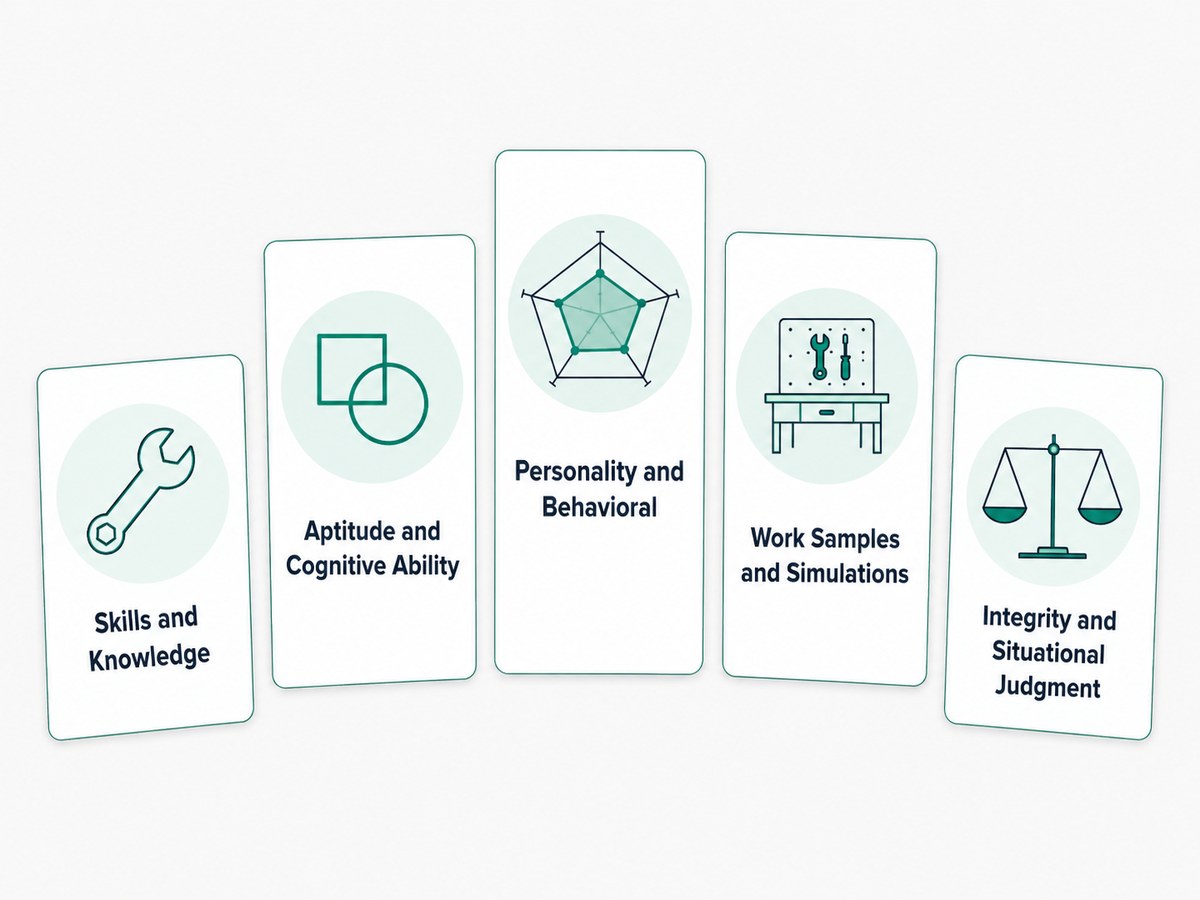
Skills and Knowledge Tests
These measure whether a candidate actually has a specific, job-relevant skill, not potential, not personality, just demonstrated capability.
- Directly tied to tasks the role requires: a coding concepts test for a developer role, a regulatory knowledge test for a compliance role, a writing sample for a content role
- Typically the most defensible type if a hiring decision is ever challenged, since the connection to the job is explicit and easy to explain
- Best suited to multiple-choice or written-response formats, which grade quickly and scale to high applicant volumes
Aptitude and Cognitive Ability Tests
These measure general reasoning ability - verbal, numerical, logical - rather than a specific existing skill.
- Predict how quickly someone can learn and adapt, which matters more for roles where the job itself will keep changing
- Don't require the candidate to already know the job's specific content, which makes them useful for entry-level or career-change hiring
- Tend to be shorter and more standardized than skills tests, often adapted from established test formats rather than built fresh per role
Personality and Behavioral Assessments
These measure work style, interpersonal tendencies, and how someone tends to behave in specific situations, rather than what they know or can do.
- Useful for understanding fit and work style, but weak as a stand-alone hiring filter - they measure tendencies, not competence
- Should generally be used to inform a conversation, not to disqualify a candidate outright
- Easier for candidates to answer in a way that presents themselves favorably compared to a knowledge test with clearly right and wrong answers
Work Samples and Job Simulations
These ask a candidate to actually do a small piece of the job, write a sample piece, solve a scenario, complete a task closely resembling real work.
- Often the strongest single predictor of on-the-job performance, since it's the closest thing to directly observing the work itself
- More time-consuming to build and to complete than a standardized test, which limits how early in a large applicant funnel it's practical to use
- Works well as a later-stage filter, once a pool has already been narrowed by a faster assessment
Integrity and Situational Judgment Tests
These present scenarios, often ethically ambiguous or operationally tricky ones, and ask how a candidate would respond.
- Aim to predict counterproductive behaviors (dishonesty, poor judgment under pressure) rather than skill or knowledge
- Used more selectively than the other types, often for roles involving financial access, safety responsibility, or significant autonomy
- Results should be interpreted cautiously and combined with other signals, since self-reported judgment doesn't always match real behavior under actual pressure
How Common Is Pre-Employment Testing, and Where
Testing usage isn't uniform across role levels. Broader workforce research suggests assessments are used considerably more often for middle management and senior roles than for entry-level positions, reflecting that the cost of a bad hire, and the value of a more rigorous screen, tends to rise with the seniority and responsibility of the role. That doesn't mean testing is only useful for senior hiring; it just explains why adoption skews that direction.
How to Choose the Right Type for a Role
Picking the wrong assessment type for a role is a common and avoidable mistake - a personality test won't tell you if someone can actually do the job, and a pure knowledge test won't tell you much about fit.
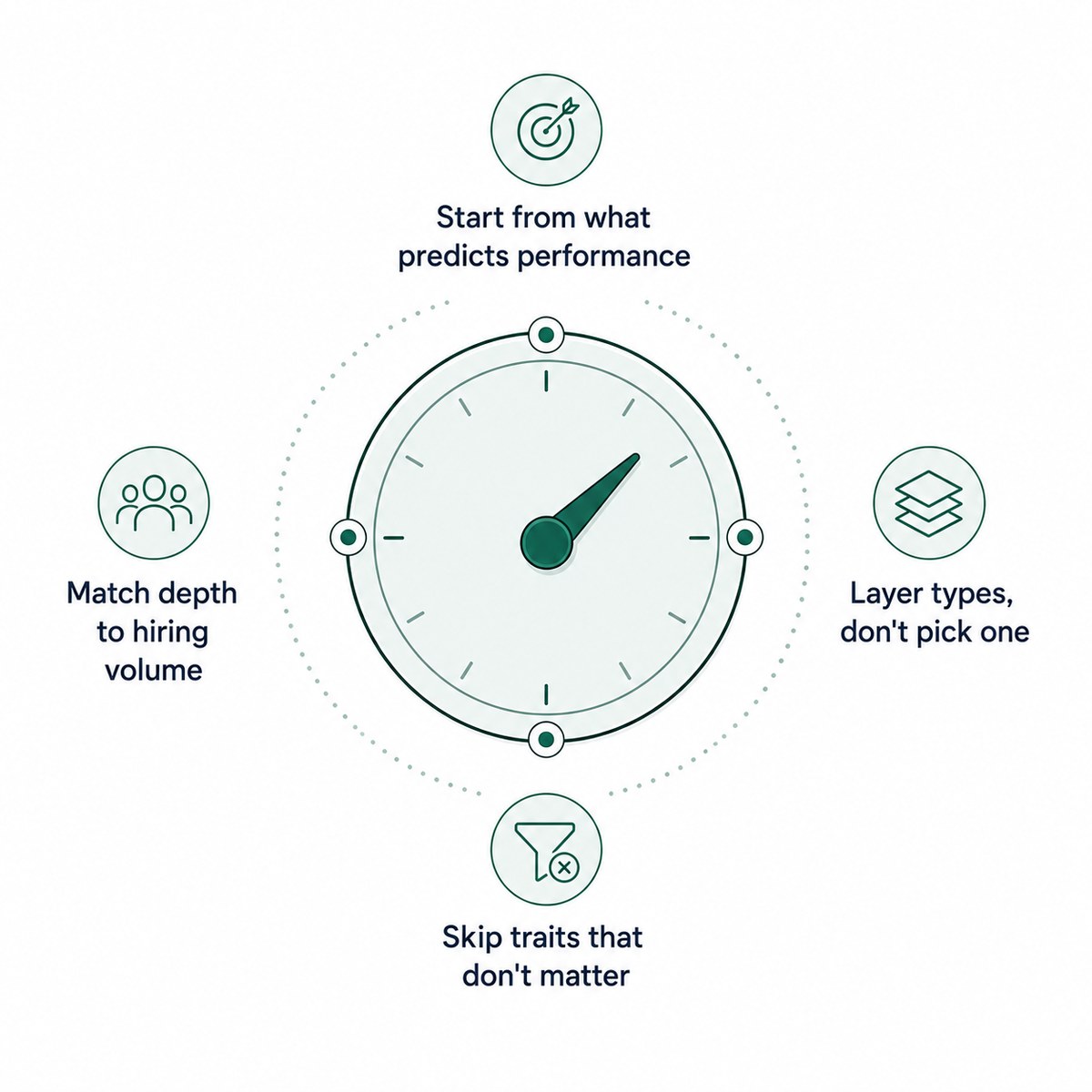
- Start from what actually predicts success in this specific role - is it existing skill, learning speed, judgment, or work style that matters most?
- Match assessment depth to hiring volume - a fast skills or aptitude test scales to hundreds of applicants; a work sample doesn't
- Layer types rather than picking just one - a knowledge test to filter, followed by a work sample or interview for the finalists, is a common and effective combination
- Avoid testing traits that aren't actually job-relevant - beyond being a weak predictor, testing for irrelevant traits raises fairness and legal concerns
For most roles hiring at any real volume, a multiple-choice or written-response skills test tends to be the practical starting point, fast to build, fast to score, and directly tied to what the job requires. TunnelQuiz supports both question formats with instant auto-grading for multiple-choice and a simple review flow for written answers, which covers the most commonly used assessment type without needing a separate tool.
What a Pre-Employment Assessment Can't Tell You
It's worth being direct about the limits here. No single assessment type captures the full picture of whether someone will succeed in a role.
- A skills test confirms current competence but says little about growth potential or adaptability
- A personality assessment describes tendencies, not guaranteed behavior in every real situation
- Even a strong work sample is a snapshot, not a guarantee of sustained performance over time
Treating any single assessment as the entire hiring decision is a common overcorrection - the more reliable approach combines a well-chosen assessment with a structured interview, so each method covers what the other misses.
The Short Version
A pre-employment assessment is a broad category covering skills tests, aptitude tests, personality assessments, work samples, and situational judgment tests, each measuring something different about a candidate, and each suited to different roles and hiring stages. The strongest hiring processes match the assessment type to what actually predicts success in the specific role, then combine it with a structured interview rather than relying on any single method alone.
Frequently asked questions
What is the difference between a pre-employment assessment and a skills test?
A skills test is one specific category within the broader term "pre-employment assessment," focused narrowly on demonstrated competence in a specific area. "Pre-employment assessment" also covers aptitude tests, personality assessments, work samples, and situational judgment tests, each measuring something different.
Are pre-employment assessments legal?
Generally yes, provided the assessment measures criteria genuinely relevant to the job and is applied consistently across candidates. Testing for traits unrelated to actual job requirements, or applying tests inconsistently across candidates, raises fairness and legal risk regardless of the assessment type used.
How long does a pre-employment assessment usually take?
It varies by type - aptitude and personality assessments are often designed to be completed in around 10-20 minutes, while skills tests and work samples can reasonably run longer depending on what they're measuring. Total length should be weighed against candidate drop-off, especially earlier in a hiring funnel.
Can a candidate fail a pre-employment assessment and still get the job?
Yes, in many hiring processes, a single assessment result is typically treated as one input among several rather than an automatic disqualifier, especially when other signals (interview performance, relevant experience) are strong. How much weight a result carries depends on how the specific hiring process is designed.
Do all companies use the same type of pre-employment assessment?
No, the type used varies significantly by role, seniority, and industry, and many hiring processes combine more than one type rather than relying on a single test. A software role and a customer service role, for example, typically call for very different assessment approaches.
Is a personality test the same as a pre-employment assessment?
No, a personality test is one specific type within the broader pre-employment assessment category, alongside skills tests, aptitude tests, work samples, and situational judgment tests. The terms are sometimes used loosely as if interchangeable, but personality testing measures only one narrow slice of what the full category covers.