Best practices for remote exams
Running a remote exam well is mostly a logistics and communication discipline rather than a technology one. Five practices that reduce disputes.

In short
Communicate early, offer a window rather than a fixed slot, have a technical-issue policy, and actually act on the feedback you collect.
Running a remote exam well comes down to preparing students thoroughly before exam day, having clear logistics for communication and technical issues during the exam itself, and following up afterward with feedback that closes the loop. Most remote exam problems aren't really about the exam content - they're about gaps in preparation, communication, or contingency planning that show up the moment something doesn't go exactly as expected.
This guide covers practical, operational best practices for the full remote exam experience, from the weeks before to the moments during. For the broader picture of building and securing online exams, see our complete guide to online exams.
Prepare Students Well Before Exam Day
Most remote exam friction traces back to something that could have been addressed earlier: a missed accommodation, an untested platform, unclear expectations.
- Review accommodation needs in advance, not the day of. Students with disability accommodations need confirmation that the remote format will actually support what they're entitled to, well before the exam window opens
- Give students a genuine dry run of the platform, including downloading, uploading, and submitting, ideally at least a week before the real exam
- Set clear expectations about collaboration and resources, in writing - what's permitted and what isn't should never be ambiguous by exam day
- Confirm students know how to reach an instructor or TA during the exam, and through what channel, before they're actually in the middle of it and stuck
A dry run in particular catches more problems than almost any other single step - technical issues surface when the stakes are low, not when a grade is on the line.
Account for Time Zones and Connectivity Realistically
Remote exams often serve a more geographically distributed group of students than an in-person exam would, and logistics need to reflect that.
- Offer a testing window rather than a single fixed time, when the exam format allows it, so students aren't disadvantaged by their location
- Build in extra time for downloading and uploading, separate from the actual working time, since this step alone can eat meaningfully into a tightly timed exam
- Have a documented policy for connectivity failures - what happens if a student's internet drops mid-exam, communicated in advance, not decided in the moment
- Consider flexible rather than rigid timing for take-home or asynchronous formats, where the format allows it, to reduce the pressure connectivity issues create
Students shouldn't have to guess what happens if their connection fails - a clear, published policy removes that uncertainty and reduces disputes afterward.
Communicate Clearly During the Exam Itself
A remote exam has no proctor walking the room to answer a quick question, so that communication channel needs a deliberate replacement.
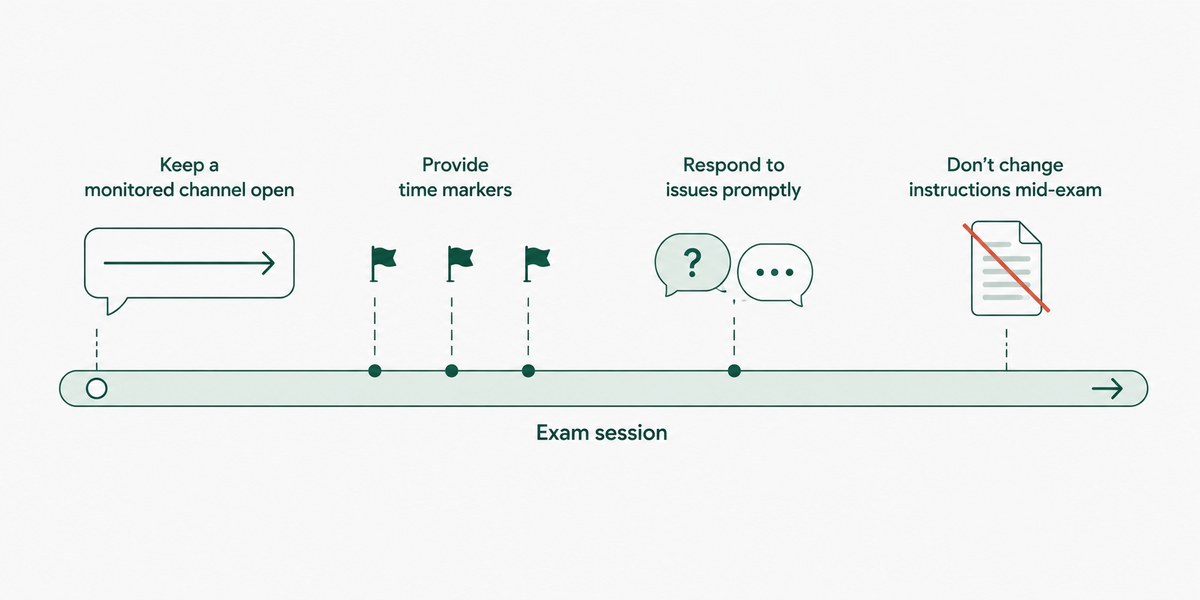
- Keep a clear, monitored channel open during the exam window - email, a messaging platform, or a video call with a waiting room - so students can ask genuine clarifying questions without disrupting others
- Provide time markers or suggested pacing for longer exams, so students can self-monitor progress without needing to ask
- Respond promptly to technical issues as they're reported, since a student stuck on a submission problem loses real exam time waiting for a reply
- Avoid making changes to instructions mid-exam unless necessary, and if you do, communicate the change through every channel students are watching
This is one of the more overlooked pieces of remote exam logistics - a strong exam design still creates a stressful experience if students have no reliable way to get help when something goes wrong.
Safeguard Integrity Without Over-Relying on One Method
No single method fully solves academic integrity in a remote exam, and the most effective approaches typically combine several lighter-touch strategies rather than one heavy-handed one.
- Communicate the honor code explicitly, and consider having students actively affirm it as part of starting the exam
- Design the assessment itself to reduce the incentive for misconduct - question banks, shuffled order, and application-based questions all lower both the opportunity and the appeal of cheating
- Consider oral follow-up for high-stakes written work, where practical, briefly asking a student to explain their own submitted reasoning is a strong, low-tech way to confirm authentic work
- Be mindful of tools students might use to circumvent the exam, without building the entire strategy around chasing every new one reactively
The deeper technical and institutional layers of this, proctoring technology and university-wide policy, are covered in their own dedicated guides; see How to Prevent Cheating in Online Exams for the technology-focused approach and How Universities Can Prevent Cheating in Online Exams for institutional policy.
Choose the Right Exam Format for a Remote Setting
Not every exam format translates equally well to a remote setting, and choosing deliberately reduces friction more than trying to force a traditional format to work remotely.
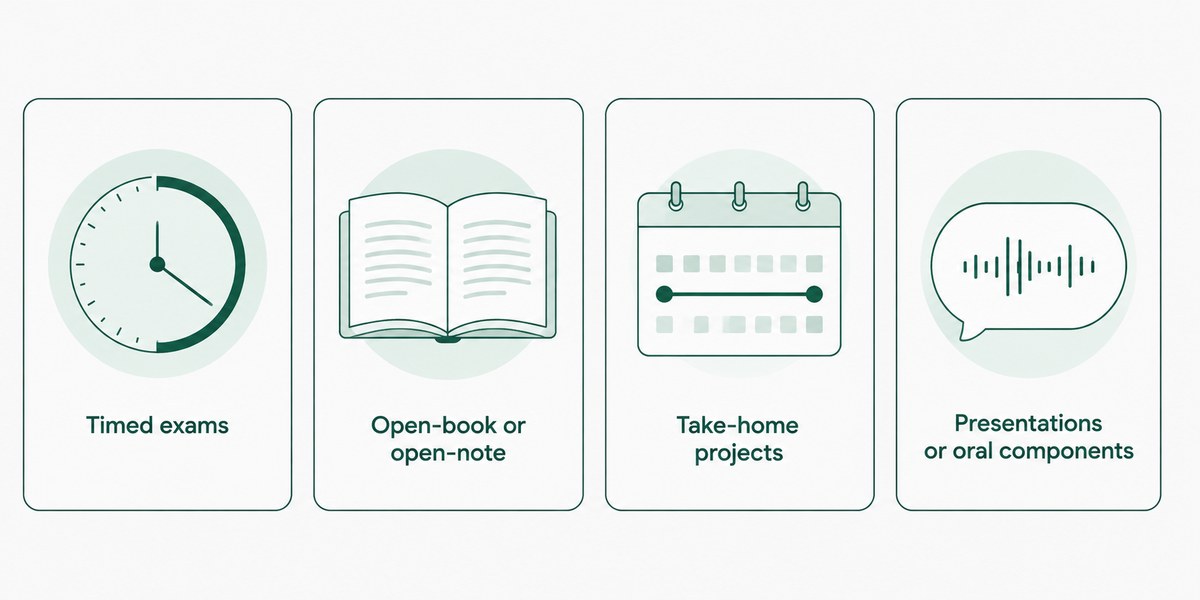
- Timed exams work well for content that benefits from time pressure, but require robust technical support given how disruptive a mid-exam technical issue becomes
- Open-book or open-note formats reduce the incentive to seek outside help, especially when paired with application-based questions that can't simply be looked up
- Take-home essays or projects with a longer window shift the format entirely away from real-time pressure, trading some integrity assurance for reduced technical risk
- Presentations or oral components can supplement a written exam, adding an authentic verification layer that's difficult to replicate through unauthorized help
TunnelQuiz supports the timed and question-bank-based formats directly, with shuffled questions per student and adjustable time limits, which covers the most common remote exam format without requiring a separate tool for basic administration.
Follow Up After the Exam
The exam isn't finished producing value the moment it's submitted - what happens afterward shapes whether the next one goes more smoothly.
- Give timely feedback, not just a score, so students understand what to improve rather than only what they got wrong
- Ask students for feedback on the remote experience itself, not just the content - technical friction points are often easier to fix than instructors assume once they're actually identified
- Report suspected misconduct through the proper institutional channel, rather than handling it informally, so the process is documented and consistent
- Revisit what worked and what didn't before the next exam cycle, rather than repeating the same process unchanged regardless of outcome
Institutions and instructors who treat this as an iterative process consistently see fewer recurring complaints than ones who set the process once and never revisit it.
The Short Version
Best practices for remote exams center on preparation, communication, and follow-up more than any single technical fix - a genuine dry run, realistic accommodations for time zones and connectivity, a clear channel for questions during the exam, and honest feedback afterward all matter more than most instructors expect going in. Getting the logistics right consistently prevents more problems than any detection technology added after the fact.
Frequently asked questions
What's the most important best practice for remote exams?
Giving students a genuine dry run of the exam platform before the real exam is one of the highest-leverage practices, since it surfaces technical and logistical problems while the stakes are still low. Most remote exam complaints trace back to a preparation gap that a dry run would have caught.
How should instructors handle time zone differences in remote exams?
Offering a testing window rather than a single fixed time slot, where the exam format allows it, is the most common and effective solution. This avoids disadvantaging students simply based on their location relative to the institution.
What should happen if a student's internet fails during a remote exam?
Having a documented, communicated-in-advance policy for connectivity failures, such as extended time or a retake option, removes ambiguity and reduces disputes compared to deciding in the moment. Students should know this policy before the exam, not learn about it only after something goes wrong.
How do you communicate with students during a remote exam?
A clear, actively monitored channel - email, messaging, or a video call with a waiting room - should be established and communicated in advance, so students can ask genuine clarifying questions without disrupting the exam for others. Prompt responses to reported technical issues matter as much as the channel itself.
Are open-book exams a good option for remote settings?
Yes, in many cases, open-book formats reduce the incentive to seek unauthorized help, especially when paired with application-based questions that require reasoning rather than simple lookup. They shift the assessment's focus toward demonstrating understanding rather than memorized recall.