How universities can prevent cheating in online exams
Institutional cheating prevention is a policy question first and a technology question second. The strongest programmes get the policy right before layering in tools.
In short
Publish the policy, design exams that are structurally harder to cheat on, match proctoring intensity to stakes, and give flagged students a real hearing.
Universities prevent cheating in online exams most effectively through a combination of a clear, consistently enforced academic integrity policy, assessment design that reduces the incentive to cheat, and a campus culture where honesty is the norm, not through any single detection tool applied after the fact. Technology plays a role, but institutions that treat proctoring software as their entire strategy tend to see worse outcomes than ones that start with policy and culture first.
This article focuses on the institutional and governance layer specifically: what a university, department, or academic integrity office actually does at the policy level. For the broader picture of running online exams well, see our complete guide to online exams.
Start With Policy, Not Technology
The strongest academic integrity programs treat policy as the foundation, with technology as a supporting layer rather than the starting point.
- Define academic dishonesty clearly and specifically - students often violate policy simply because they don't know precisely where the line is, not out of deliberate intent
- Make the policy visible everywhere, not buried in a syllabus paragraph - course pages, exam instructions, and pre-exam reminders should all reference it
- Apply the policy consistently across departments, since inconsistent enforcement (strict in one class, ignored in another) undermines the credibility of the whole system
- Review and update policy regularly, since the specific ways students attempt to cheat, including newer methods involving AI tools, shift faster than most policy documents get revised
A university-wide policy that's actually enforced consistently does more for integrity than a stack of individual instructors improvising their own rules course by course.
Build a Culture of Integrity, Not Just an Enforcement System
Universities with historically lower rates of self-reported cheating tend to share something in common: an academic integrity culture students actually buy into, not just a set of rules they're trying to avoid getting caught breaking.
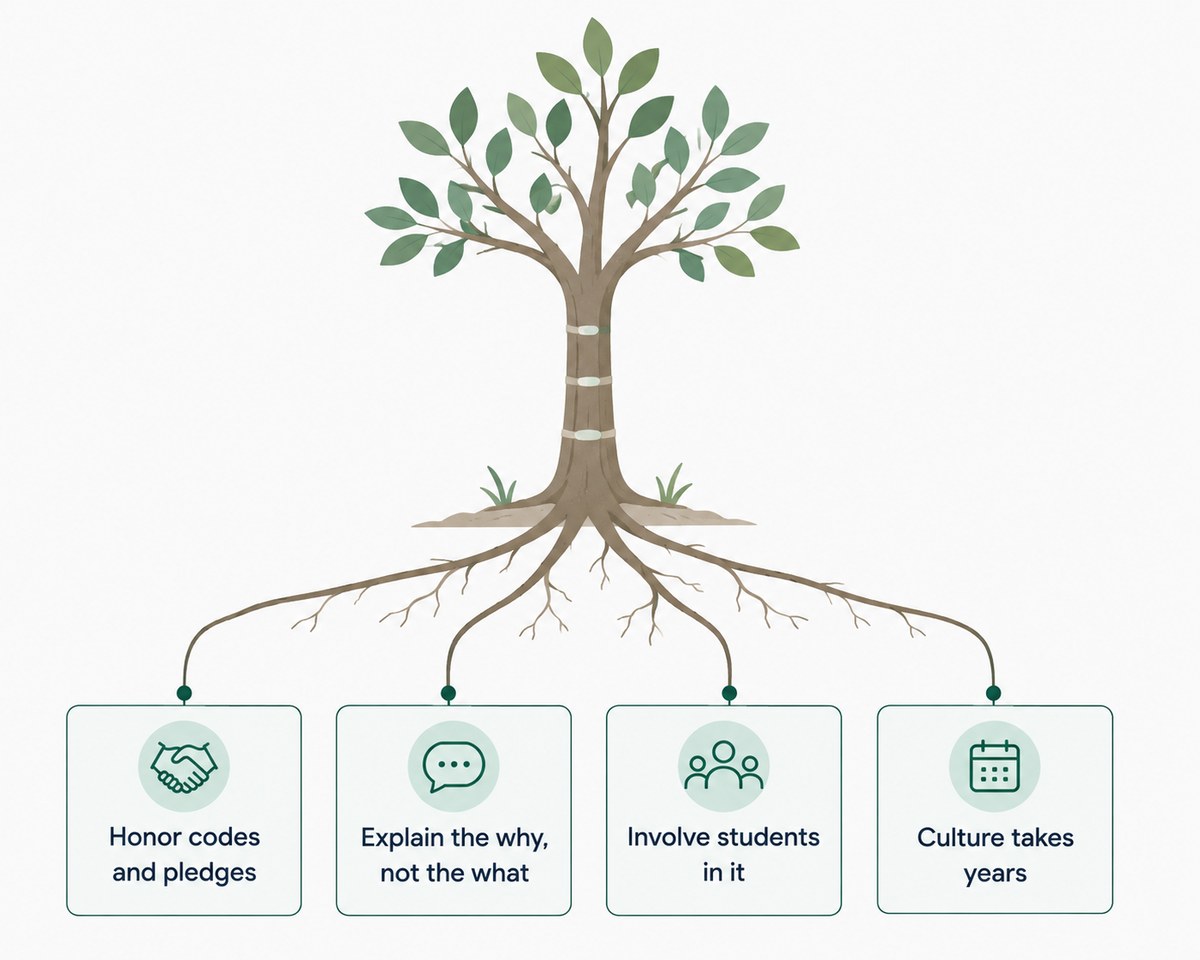
- Use honor codes and integrity pledges - requiring students to sign or affirm a commitment before an exam has a real psychological effect, reminding students of the expectation right before the moment it matters most
- Explain the "why," not just the "what" - students who understand why academic integrity matters to their own learning and credential tend to internalize it more than students who only hear about consequences
- Involve students in the conversation, through orientation programs, student conduct boards, or peer-led integrity initiatives, rather than treating integrity as something purely imposed from the administration down
- Recognize that culture takes years to build, not a single semester's policy announcement - this is a long-term institutional investment, not a quick fix
Research on academic honor codes has found that a strong campus culture of integrity can meaningfully reduce self-reported cheating rates compared to campuses without one, a finding echoed across multiple universities' own academic integrity offices, suggesting this isn't a one-off result but a broadly replicable pattern.
Design Assessments That Reduce the Incentive to Cheat
Assessment design is where policy meets practice - a well-designed exam reduces both the opportunity and the appeal of cheating, independent of any monitoring layer.
- Break high-stakes finals into frequent, lower-stakes assessments - spreading grade weight across the term reduces the pressure any single exam carries, which measurably lowers the temptation to cheat on it
- Favor application and synthesis questions over pure recall - a question that requires original reasoning is far harder to outsource to a search engine or another person than a fact-recall question
- Use randomized question pools and time limits that discourage searching for every answer without penalizing students who genuinely know the material
- Consider open-book or open-note formats deliberately, where appropriate, removing the incentive to hide notes by allowing them openly, paired with harder, application-based questions, can be more effective than trying to prevent note use outright
This connects to the broader exam-creation process - for the full guide to building assessments well, see How to Create Online Assessments for Students
Train Faculty, Not Just Students
A policy is only as strong as the instructors applying it, and faculty training is a commonly overlooked piece of institutional integrity efforts.
- Give instructors practical guidance, not just a policy document, on how to write cheating-resistant questions, how to communicate expectations clearly, and how to handle a suspected violation
- Standardize the reporting and review process across departments, so a suspected violation is handled consistently regardless of which instructor or department it originates from
- Share what's actually working across departments - a strategy that reduces incidents in one program is often transferable to another, but only if there's a mechanism for that knowledge to spread
Instructors who feel equipped to handle integrity issues confidently and fairly are less likely to either over-penalize ambiguous situations or ignore genuine ones out of uncertainty about the process.
Use Technology as a Layer, Not the Whole Strategy
Detection technology, AI-based monitoring, plagiarism detection, secure browser lockdown, genuinely helps, but institutions that lead with technology instead of policy and design tend to see more disputes, not fewer.
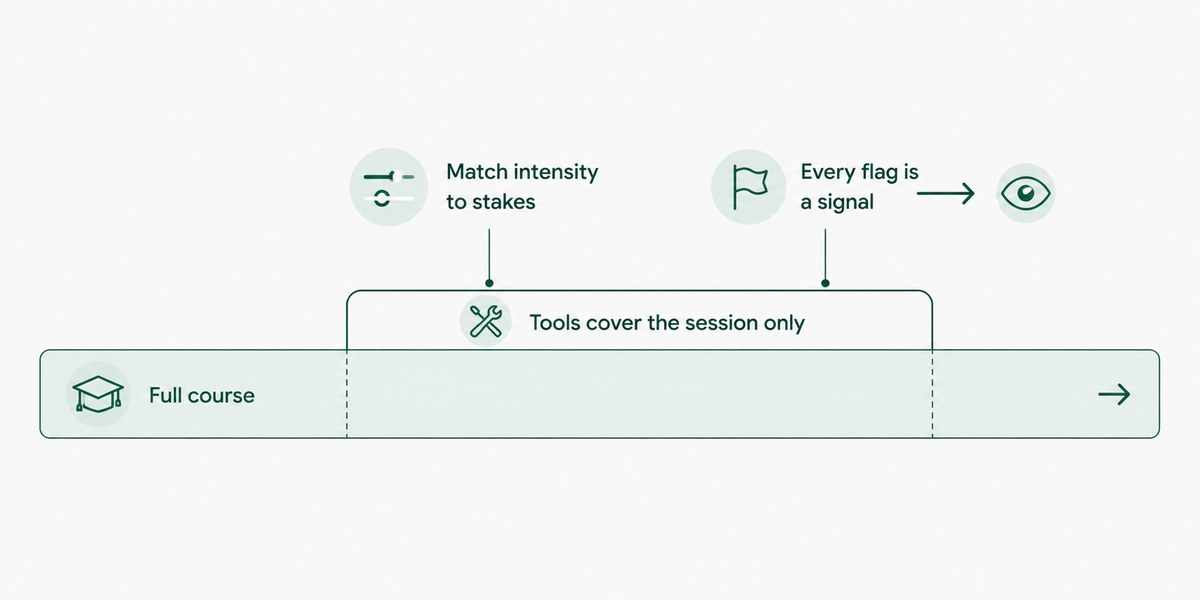
- Match monitoring intensity to exam stakes, using lighter tools for low-stakes assessments and reserving more rigorous monitoring for high-stakes finals
- Treat every technology flag as a signal for human review, never an automatic penalty
- Remember that proctoring tools mainly address the exam-session environment - they don't verify authorship on take-home essays or projects, which need a different kind of integrity check entirely
The technical details of how monitoring and detection technology actually work, AI behavioral analysis, tab-switching detection, and what these tools can and can't catch are covered in depth in our proctoring guide; see How to Prevent Cheating in Online Exams for the tactical and technical layer that complements the institutional strategy covered here.
TunnelQuiz supports this layered approach on the assessment side specifically - randomized question banks, tests you can duplicate each term, and identity verification give institutions the assessment-design tools to reduce cheating opportunity, which pairs naturally with whatever policy and culture work a department is doing separately.
The Short Version
Universities prevent cheating in online exams most effectively by starting with clear, consistently enforced policy and a genuine culture of integrity, then designing assessments that reduce the incentive to cheat, training faculty to apply policy fairly, and using detection technology as one supporting layer rather than the entire strategy. Institutions that get the policy and culture layer right generally see fewer disputes from their technology layer too, since students better understand what's expected before they ever sit down for the exam.
Frequently asked questions
What is the most effective way for universities to prevent cheating in online exams?
No single method is fully effective on its own - the strongest approach combines clear, consistently enforced policy, assessment design that reduces incentive, and a genuine campus culture of integrity, with technology as a supporting layer. Institutions that rely on detection technology alone, without the policy and design foundation, tend to see more disputes and inconsistent outcomes.
Do honor codes actually reduce cheating?
Research on academic integrity broadly suggests that a strong campus culture reinforced by honor codes and integrity pledges is associated with lower rates of self-reported cheating compared to campuses without one. The effect appears to come from students internalizing the expectation, not just from the pledge itself as a formality.
Should universities rely on proctoring software to stop cheating?
Proctoring software is a useful layer, but relying on it exclusively misses a large part of the problem, since it primarily addresses the exam-session environment and doesn't cover authorship verification on essays or take-home work. A layered approach combining policy, assessment design, and technology consistently outperforms technology alone.
How can assessment design reduce cheating without adding monitoring?
Breaking high-stakes exams into frequent, lower-stakes assessments reduces the pressure tied to any single exam, and using application-based questions instead of pure recall makes answers much harder to look up or share. Both approaches reduce the incentive to cheat independent of any detection technology.
Why do students cheat even when policies exist?
Common reasons include not fully understanding where the line is, high pressure tied to a single high-stakes exam, and a campus culture where integrity feels like an imposed rule rather than a shared value. Addressing all three - clarity, assessment pressure, and culture – tends to be more effective than addressing policy enforcement alone.