Online assessment vs resume screening
Resumes and assessments measure different things. A comparison across what each captures, bias risk, speed at scale and predictive strength.

In short
Not really competitors. A resume tells you about trajectory; an assessment tells you about capability a resume can only imply.
Online assessment and resume screening measure fundamentally different things: a resume tells you what a candidate claims to have done, while an assessment measures what they can actually demonstrate right now. Neither is a strict replacement for the other - the real question isn't which one wins, but which one should come first, and how much weight each deserves in your specific hiring process.
This article compares both directly, including a genuinely useful and slightly counterintuitive finding about which order produces better hires. For the broader picture of building a recruitment testing process, see our complete guide to online assessment for recruitment.
What Each Method Actually Measures
Resume screening evaluates claimed history: job titles, tenure, education, listed skills, usually scanned manually or filtered by an applicant tracking system for keywords and criteria matches.
Online assessment evaluates demonstrated ability: a candidate answers questions or completes tasks that directly test a skill, scored consistently against the same standard for every applicant.
The core difference isn't really about technology. It's about self-report versus direct measurement. A resume is written by the candidate, about the candidate, with an obvious incentive to present favorably. An assessment result is generated by the candidate's actual performance against a fixed standard.
Side-by-Side Comparison
| Factor | Resume Screening | Online Assessment |
|---|---|---|
| What it measures | Claimed experience, credentials, career history | Demonstrated skill or knowledge, measured directly |
| Bias risk | Higher, school names, employment gaps, and formatting can influence judgment | Lower, when questions are well-designed and scored consistently |
| Speed at high volume | Fast to skim per resume, but accuracy drops as volume grows | Consistent speed and quality regardless of pool size |
| Candidate effort | Passive, submit and wait | Active, requires completing a task |
| Predictive strength | Weaker on its own for job performance | Generally stronger for the specific skill being tested |
| Cost per candidate | Low for automated ATS filtering, high for manual review at scale | Low and consistent once the assessment is built |
Where Resume Screening Still Wins
Resume screening isn't obsolete - it's genuinely useful for what it's actually good at.
- Fast initial filtering on hard requirements - years of experience, specific credentials, required certifications that are simple pass/fail criteria
- Cheap at scale when automated through an applicant tracking system, especially for filtering out applicants who clearly don't meet baseline requirements
- Career trajectory context an assessment can't capture, growth pattern, relevant industry exposure, the shape of someone's experience over time
The weakness isn't that resumes are useless - it's that a resume alone is a poor predictor of whether someone can actually do the job, and manual review accuracy degrades fast once volume climbs into the hundreds.
Where Online Assessment Wins
- Directly measures the thing you actually care about - can this person do the task, not just claim to have done something similar
- Reduces reliance on signals prone to bias - school prestige, employment gaps, and resume formatting quality all correlate weakly with job performance but strongly influence human judgment
- Scales without losing accuracy - a thousand candidates get evaluated against the same standard as consistently as the first ten
- Surfaces strong candidates a resume filter would reject - someone with unconventional experience but real skill often gets screened out by keyword-based resume filtering before a human ever sees them
The trade-off is candidate effort: an assessment asks more of someone upfront than simply submitting a resume, which is part of why sequencing matters.
Does the Order Actually Matter?
Conventional advice says screen resumes first because it's cheap, then only assess the survivors, since assessments cost more candidate time and goodwill. That logic isn't wrong, but it's not the whole picture either.
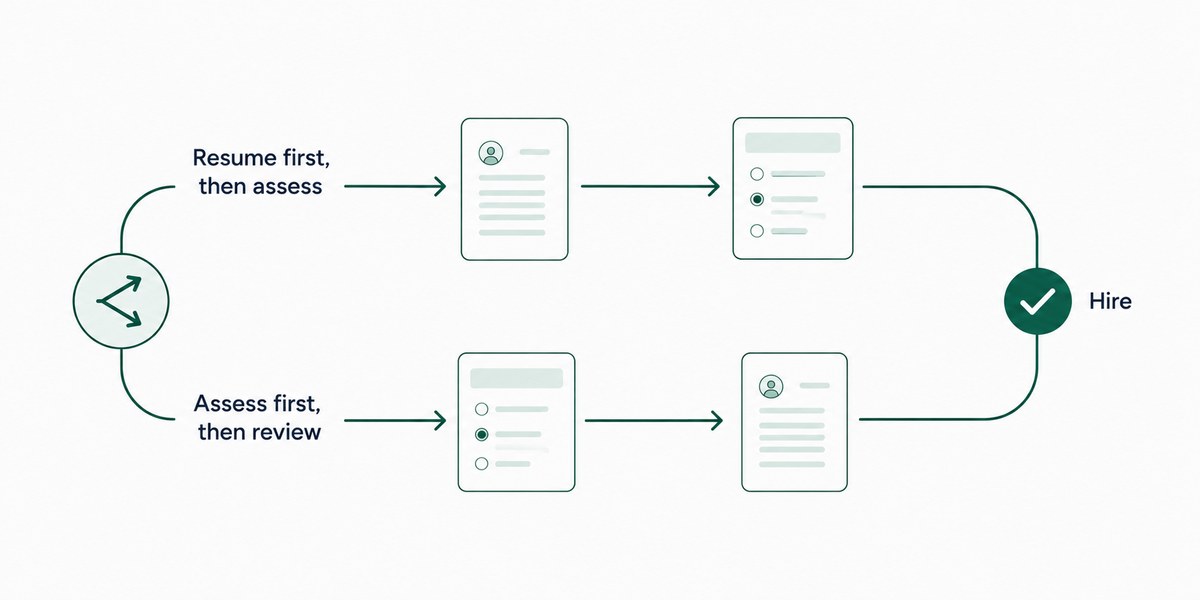
A recent industry survey of over 1,000 hiring decision-makers found that most organizations do follow that resume-first sequence, but a smaller group that assesses candidates before screening resumes reported a meaningfully higher rate of quality hires. That doesn't prove assessment-first is right for every role - a small team hiring for one specialized position has different constraints than a company running a 500-applicant campus drive, but it's a real signal that "resume first, always" isn't as settled a rule as most hiring advice assumes.
The more useful framing: for roles where the skill being tested is cheap to assess and central to the job, testing early can outperform the traditional funnel. For roles where a resume genuinely disqualifies most of the pool on hard requirements, filtering first still makes practical sense.
How to Combine Both Effectively
Most well-run hiring processes don't choose one over the other - they sequence both deliberately based on the role.
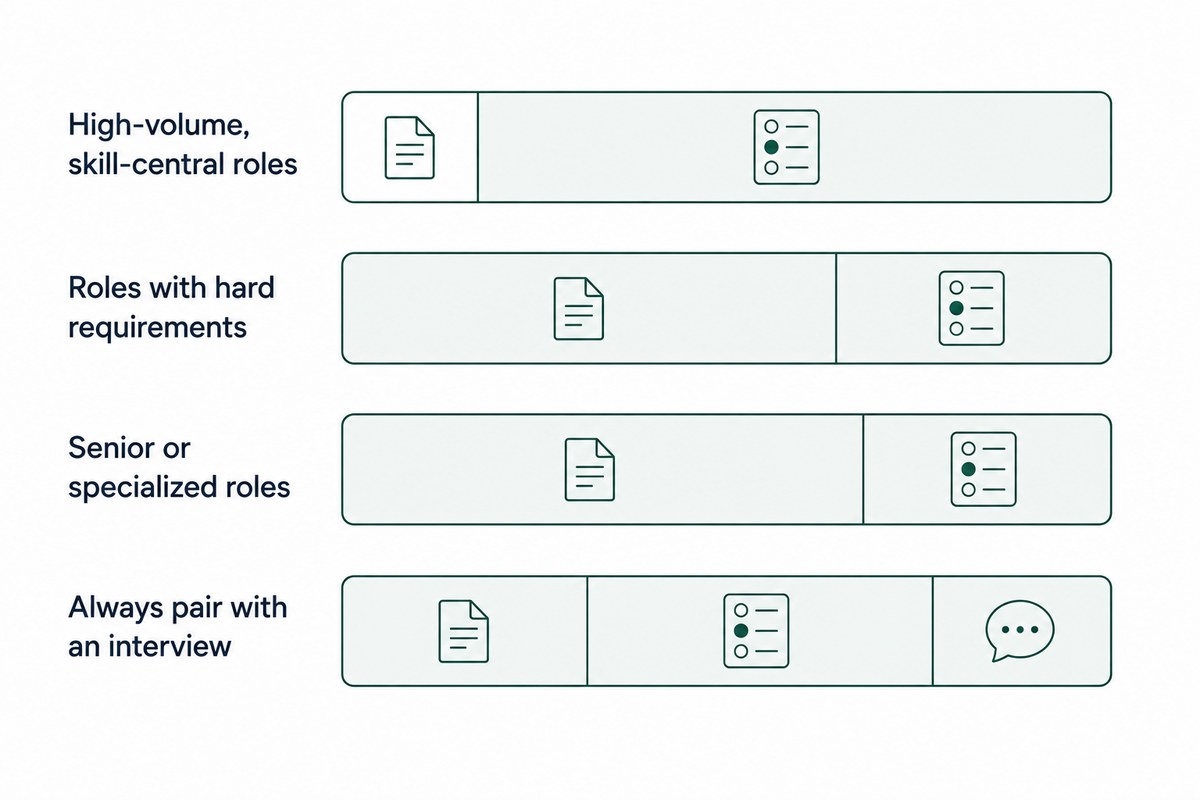
- For high-volume, skill-central roles - consider testing early, or at least alongside an initial resume pass, rather than treating the resume as the sole gate
- For roles with genuine hard requirements (a license, a specific certification) - filter on those first, since no assessment result should override a legal or regulatory requirement
- For senior or highly specialized roles - resume context matters more, since career trajectory and specific prior experience carry real signal an assessment can't replace
- Always pair either method with a structured interview - neither a resume nor an assessment score should be the sole basis for a final hiring decision
Once a shortlist is assessed, a side-by-side comparison of candidates on the same questions, which TunnelQuiz's reporting includes on Pro, makes it much easier to defend a decision with actual evidence instead of resume-based gut feel.
The Short Version
Online assessment and resume screening measure different things, claimed history versus demonstrated skill, and the better question isn't which one to use, but how to sequence and weight both based on the role. Testing early can outperform the traditional resume-first funnel for certain roles, but resumes still carry real value for context and hard requirements an assessment can't replace.
Frequently asked questions
Is an online assessment more accurate than resume screening?
For measuring actual skill or job-relevant knowledge, yes, an assessment directly tests capability, while a resume only reflects claimed experience. Resumes remain useful for filtering on hard, easily verified requirements like specific credentials, but they're a weaker predictor of on-the-job performance on their own.
Should I screen resumes before or after an assessment?
It depends on the role. Traditional practice screens resumes first to save cost, but survey data suggests testing before or alongside resume screening can produce a higher rate of quality hires for certain roles. High-volume, skill-central positions tend to benefit most from testing earlier in the process.
Does resume screening introduce more bias than online assessments?
Generally, yes, resumes are prone to bias from school prestige, employment gaps, and formatting quality, factors that correlate weakly with job performance but strongly influence human judgment. Well-designed assessments reduce this by scoring every candidate against the same standard.
Can online assessments completely replace resume screening?
Not entirely - resumes still provide useful context like career trajectory and specific prior experience that an assessment doesn't capture, and some hard requirements (licenses, certifications) are more efficiently confirmed through a resume or application form. Most effective processes use both rather than eliminating one.
Which method is cheaper for high-volume hiring?
Both can be cost-effective at scale, but for very high applicant volumes, automated resume filtering has a lower per-candidate cost than manual resume review, while a well-built online assessment maintains consistent cost and accuracy regardless of pool size. The more expensive option is usually manual resume review done at scale, not either automated method.