Online exams vs in-person exams
Neither format is a strict upgrade on the other. How they trade off across flexibility, scale, cost, integrity assurance, equipment and accessibility.
In short
Six factors where the two formats genuinely differ, and why most institutions end up somewhere in between rather than fully committing to one.
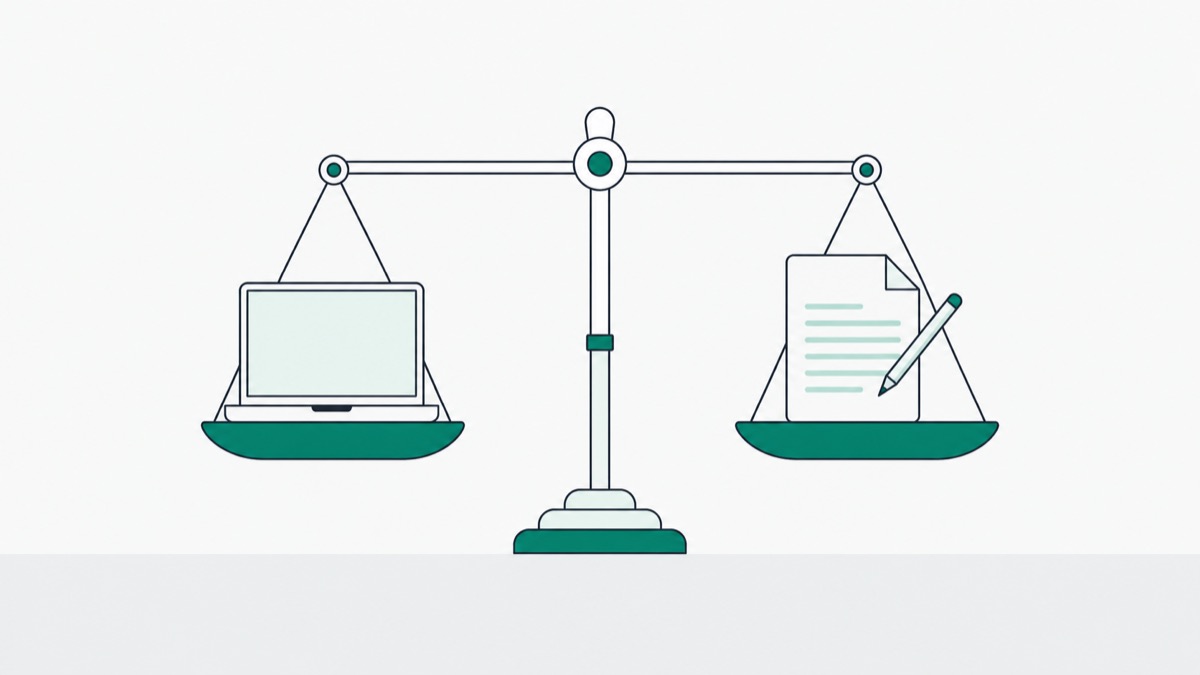
Online exams let students test remotely, on their own device, often with more flexibility around timing and location, while in-person exams take place in a supervised physical setting with built-in oversight and no dependency on technology. Neither format is categorically better - each trades convenience and cost against oversight and consistency in different ways, and the right choice depends heavily on what's actually being tested and who's taking it.
This article compares both directly across the factors that actually matter for a decision: integrity, cost, accessibility, and what each format is genuinely good and bad at. For the broader picture of running exams well in either format, see our complete guide to online exams.
Side-by-Side Comparison
| Factor | Online Exams | In-Person Exams |
|---|---|---|
| Location flexibility | Test from home or anywhere with a stable connection | Requires travel to a fixed physical location |
| Built-in oversight | Requires deliberate identity verification and monitoring setup | Built in through physical presence and in-room supervision |
| Equipment dependency | Requires a working device, camera, and stable internet | Minimal: pen, paper, sometimes a school computer |
| Cost to administer | Lower ongoing cost once platform is set up | Higher: venue, printed materials, in-person staffing |
| Environment consistency | Varies by student's home setup | Consistent, controlled testing conditions for everyone |
| Best suited for | Knowledge and skills tests, high-volume or distributed cohorts | Practical, hands-on, or lab-based assessments |
| Accessibility approach | Flexible timing and format adjustments, but tech-dependent | Requires advance arrangement, but no tech barrier |
Where Online Exams Genuinely Win
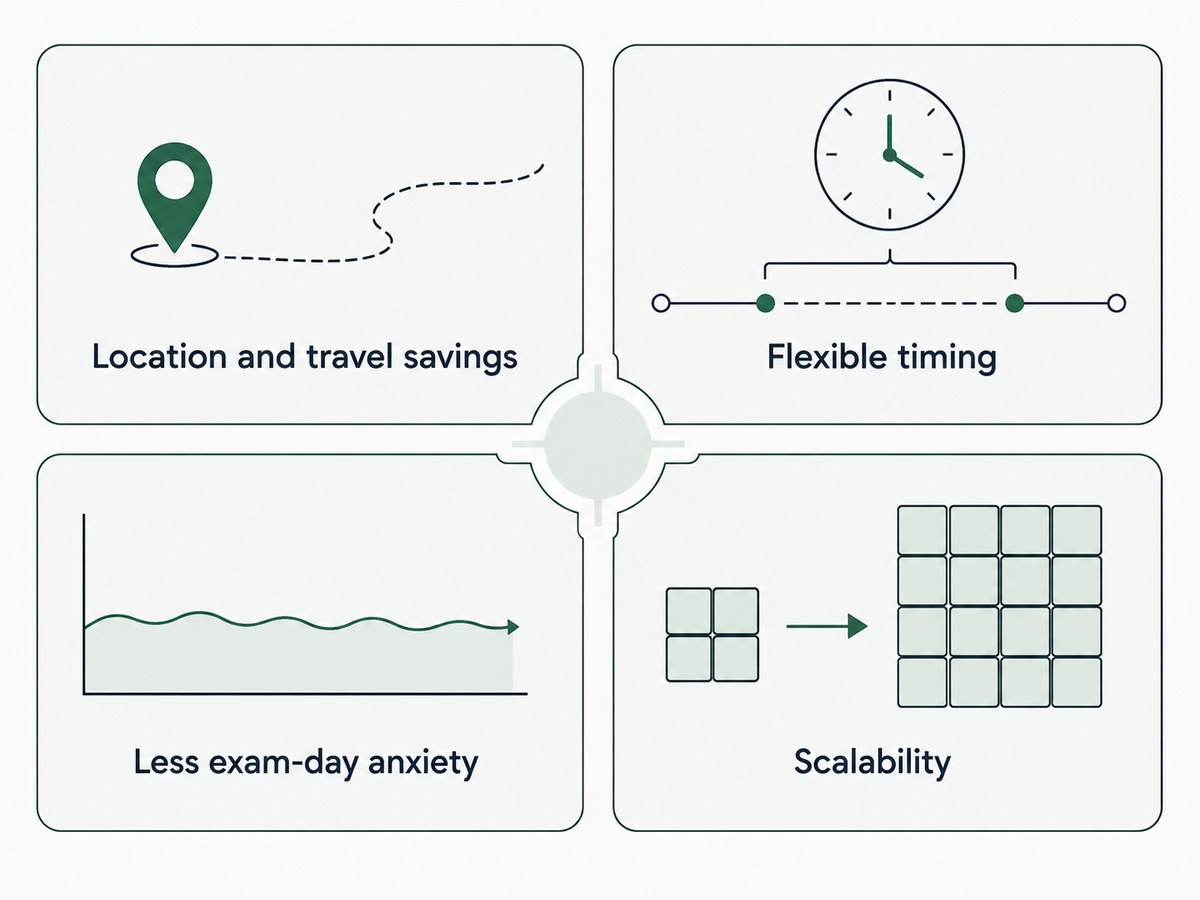
- Location and travel savings - no commute, no venue cost, and meaningful access for students in remote areas who'd otherwise face hours of travel to a testing center
- Flexibility around timing - a testing window rather than one fixed slot accommodates students across time zones or with conflicting schedules
- Reduced exam-day anxiety for some students - a familiar environment can genuinely lower stress for students who find crowded testing rooms distracting or intimidating
- Scalability - administering an exam to a few dozen students costs about the same operationally as administering it to several thousand
These benefits are real, but they come with a catch: the comfort of testing from home only helps if a student's setup, internet, device, quiet space, actually supports it. For a student without reliable access to any of those, "flexible" quickly becomes "harder."
Where In-Person Exams Genuinely Win
- Built-in integrity - physical presence and a proctor in the room provide oversight that online exams have to actively engineer through separate identity verification and monitoring tools
- No technology dependency - no risk of a dropped connection, a webcam failure, or a browser crash disrupting the exam
- Consistent testing conditions - every student faces the same room, the same lighting, the same level of quiet, removing a variable that varies wildly between students' homes
- The only realistic option for hands-on or practical assessment - a lab practical, a clinical skills check, or anything requiring physical equipment generally can't be replicated meaningfully online
The trade-off is cost and access, venue space, staffing, and the requirement that every student physically show up, which becomes a genuine barrier for students juggling work, distance, or mobility limitations.
Cost and Logistics
For institutions weighing this at scale, cost isn't just about the exam itself - it's about everything surrounding it.
- In-person exams carry ongoing venue, staffing, and material costs that scale with the number of students and exam sessions
- Online exams have a front-loaded setup cost - building the platform and process - but a much lower marginal cost per additional student once that's in place
- Students bear different costs too - travel, parking, and time for in-person exams; a reliable device and internet connection for online ones, which isn't a given for every student
Neither cost structure is universally cheaper - it depends heavily on scale, geography, and how many students already have reliable access to the technology an online format requires.
Academic Integrity: A Real Trade-Off, Not a Settled Question
This is where the comparison gets genuinely nuanced rather than one format having a clear advantage.
- In-person exams have integrity built into the setting itself - a proctor in the room, no access to outside devices, and social pressure from visibly testing alongside peers
- Online exams have to actively construct that same level of assurance through identity verification, monitoring technology, and thoughtful exam design, none of which is automatic
- Some evidence suggests students perceive online exams as easier to cheat on, which can itself affect behavior independent of whether the actual safeguards in place are comparable
Done well, an online exam's integrity measures can approach what an in-person exam provides by default, but "done well" requires deliberate effort that in-person exams get for free. For the full breakdown of what conducting a secure online exam actually involves, read How to Conduct a Secure Online Exam
How to Decide Which Format Fits
Rather than treating this as an all-or-nothing choice, most institutions benefit from deciding format on a case-by-case basis.
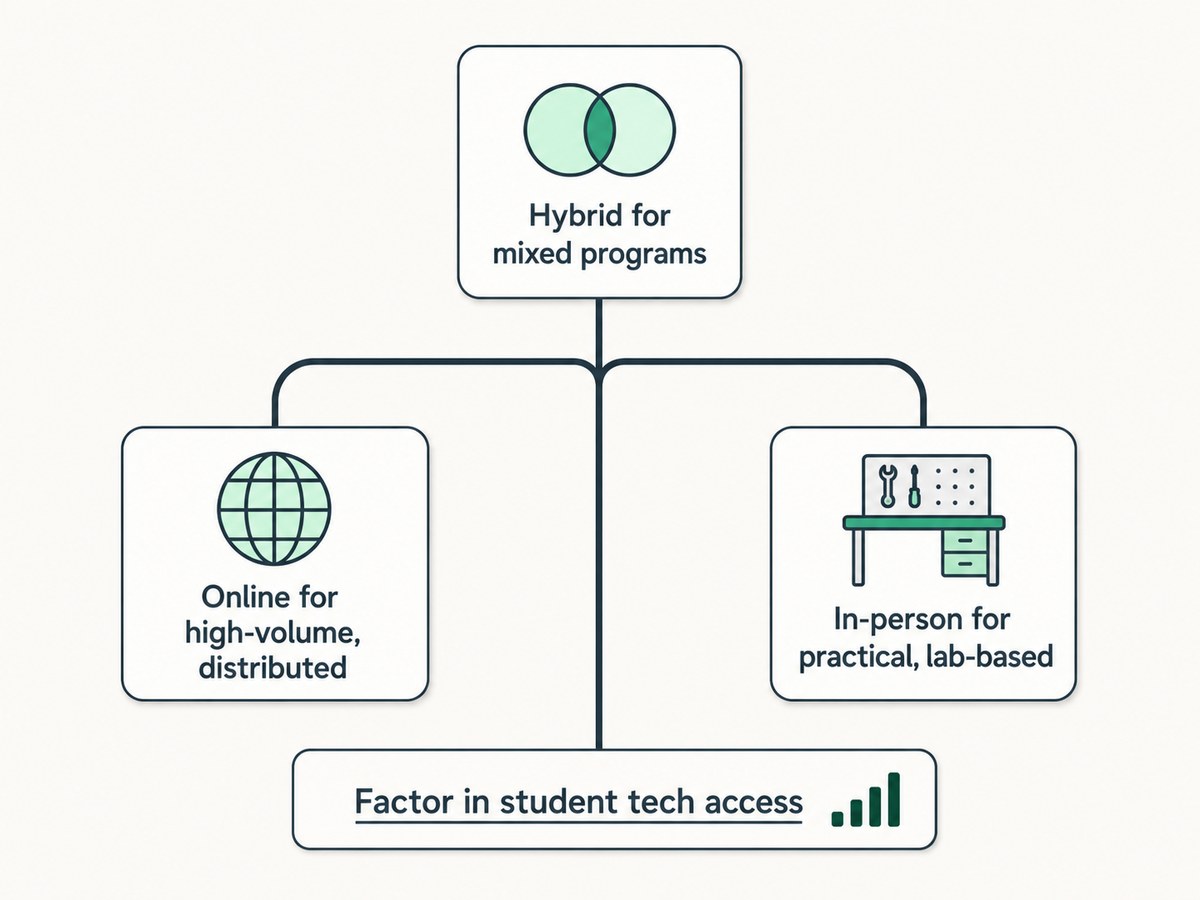
- Choose online for high-volume, distributed, or knowledge-based assessments where flexibility and scale matter more than hands-on evaluation
- Choose in-person for practical, lab-based, or licensing-adjacent exams where physical skill demonstration or maximum integrity assurance is essential
- Consider a hybrid approach - online exams for regular coursework, in-person for high-stakes finals or licensing exams - which many institutions have settled into as the practical middle ground
- Factor in your actual student population's access to reliable technology, not just institutional convenience, before defaulting to online for everything
The format decision should follow from what's actually being tested and who's taking it, not from which option is simpler to administer on the institution's end.
The Short Version
Online and in-person exams trade different strengths: flexibility, scale, and cost efficiency for online; built-in integrity, consistency, and no technology dependency for in-person. Neither format wins outright, and the smartest approach for most institutions is choosing deliberately based on what's actually being tested rather than defaulting to one format for everything.
Frequently asked questions
Are online exams easier than in-person exams?
Not inherently - online exams test the same material and require the same underlying knowledge, though the format itself (typing versus handwriting, screen navigation versus paper) changes how that knowledge gets demonstrated. A common misconception is that online format alone reduces difficulty, which isn't generally true.
Which is more secure, online or in-person exams?
In-person exams have integrity built into the physical setting by default, while online exams require deliberate identity verification and monitoring to reach a comparable level of assurance. With the right measures in place, a well-run online exam can achieve strong security, but it takes active effort rather than coming built in.
Do online exams cost less than in-person exams?
Generally, yes, for administering large-scale exams once the platform is set up, since online formats avoid venue and in-person staffing costs. However, online exams shift some cost onto students who need reliable technology, which isn't a universal or free assumption.
Can all exams be conducted online?
No, practical, lab-based, or hands-on skills exams generally require physical presence to assess accurately, since demonstrating a physical skill doesn't translate meaningfully to a screen-based format. Knowledge and concept-based exams are much better suited to the online format.
Do students perform differently on online exams compared to in-person ones?
Performance can vary based on individual factors - some students perform better in a familiar, low-pressure home environment, while others benefit from the structure and reduced distraction of a supervised in-person setting. There's no universal answer; it depends significantly on the individual student and the specific exam format.